
In 2026, scaling a B2B company and expanding your social media footprint no longer requires a massive marketing department. Instead, forward-thinking brands are deploying autonomous marketing platforms to orchestrate, execute, and optimize campaigns around the clock.
Traditional marketing automation systems are reaching their limits. Companies are tired of designing rigid flowcharts, drafting repetitive email follow-ups, and managing disjointed SaaS tools. Today, the industry is shifting toward autonomous marketing platforms. Rather than following hardcoded rules, these advanced systems utilize goal-oriented AI agents to research target audiences, write high-converting copy, design assets, and dynamically optimize performance in real time.
At the center of this transformation is Vect AI, a comprehensive marketing operating system designed to handle the entire lifecycle of marketing orchestration.
In this guide, we will explore the landscape of autonomous marketing platforms, discuss how they drive growth, explain their underlying multi-agent architecture, and provide a step-by-step framework to launch your first autonomous campaign.
What is an Autonomous Marketing Platform?
To understand the value of autonomous platforms, it helps to distinguish them from traditional automation. Traditional software like HubSpot or ActiveCampaign is rule-based: If a user downloads an eBook, wait three days, then send Email B.
While functional, this approach suffers from significant limitations:
- High Overhead: Marketing teams spend hours configuring, testing, and debugging workflows.
- Static Copy: Messages are pre-written templates that fail to address the specific, changing concerns of individual leads.
- No Adaptation: If an ad campaign underperforms, the system cannot rewrite the copy, design new images, or adjust the budget distribution without manual work.
In contrast, autonomous marketing platforms use goal-oriented AI agents. Instead of defining every step, you provide a clear business objective (e.g., "Increase qualified signups for our enterprise software by 25% this month"). The platform's orchestrator agent then coordinates specialized researcher, writer, designer, and analyst agents to build, distribute, and optimize the campaign autonomously.
The Landscape of Marketing Automation in 2026
Choosing the right platform depends on your specific business goals, technical requirements, and channel preferences:
| Platform | Core Specialization | Key Feature | Target Audience |
|---|---|---|---|
| Vect AI | Full-Stack Multi-Agent Orchestration | Campaign Builder & Brand Kernel | B2B SaaS, Agencies, & Enterprises |
| Clay | Data Enrichment & Personalization | Multichannel Scraping & Enrichment | Outbound SDR Teams |
| HubSpot | Contact Management & Rule-Based Flows | CRM Integration & Email Sequencer | General Marketing Teams |
| Jasper | Content Generation | Brand Voice Profiles | Individual Copywriters |
While Clay is powerful for data enrichment and Jasper is useful for individual copywriting tasks, Vect AI stands out as the only platform that offers a complete, closed-loop execution system. By automating everything from initial research and asset creation to direct publishing and conversion optimization, Vect AI functions as an always-on digital marketing department.
Core Benefits of Autonomous Marketing for B2B Growth
Deploying an autonomous marketing stack provides B2B SaaS companies, agencies, and enterprises with major operational benefits:
1. Simplified Multi-Channel Campaign Orchestration
Running a successful campaign usually involves coordinating a blog post, a newsletter, social media updates, and landing page designs. Managing these assets manually across multiple tools leads to fragmented messaging and delays.
With Vect AI's Campaign Builder, the entire process is unified. Once you enter your brief, the system's orchestrator automatically coordinates specialized AI agents to generate, verify, and schedule all required assets. This ensures your brand messaging remains completely aligned across every marketing channel.
2. Signal-Based Lead Generation
Generic cold outbound emails are no longer effective in modern B2B sales. Successful lead generation now requires highly personalized outreach driven by real-time events.
By combining Vect AI's AI Lead Generation tools with a comprehensive Signal-Based Selling Guide, autonomous agents can continuously monitor public data sources—such as hiring patterns, executive moves, and funding rounds. When a prospect triggers a relevant signal, the AI agent automatically crafts and sends a personalized pitch tailored to that exact situation.
3. Automated Funnel and Conversion Optimization
Many B2B sites lose valuable traffic because their landing pages are static and rarely updated.
Autonomous platforms solve this by continuously auditing your user funnels. Using the Conversion Killer Detector Guide and the AI Landing Page Roaster, AI agents analyze user behavior, scroll maps, and drop-off rates. The system then automatically runs A/B tests on headers, form layouts, and copy, implementing the highest-converting variations without requiring developer help.
Core Benefits of Autonomous Marketing for Social Media Growth
Building a recognizable brand on social media requires consistency, platform-specific formatting, and rapid responses to industry trends. Autonomous platforms act as a dedicated, round-the-clock social media agency.
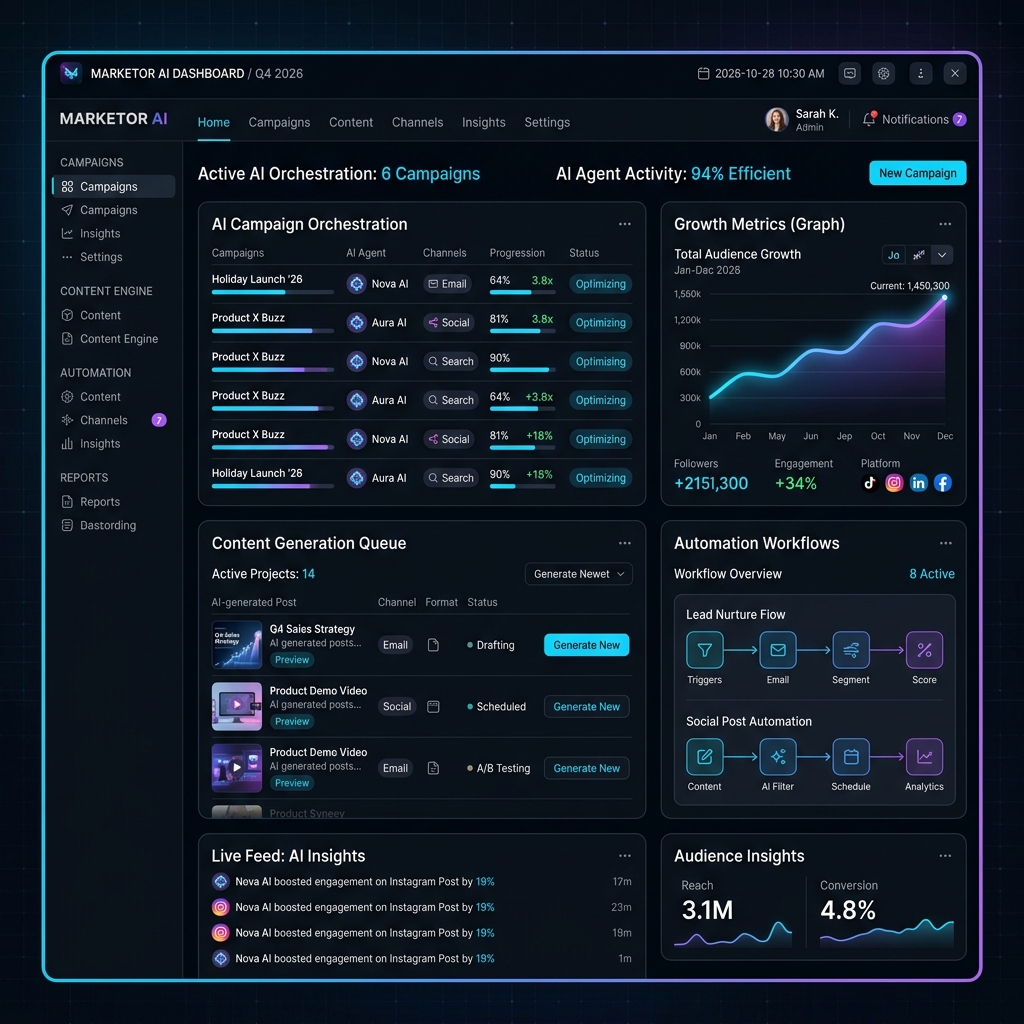
1. Dynamic Content Adaptation
Re-posting the exact same message across different social networks rarely works because every platform has its own formatting rules, algorithms, and audience expectations.
AI agents resolve this by automatically adapting your core content:
- LinkedIn: The AI LinkedIn Post Generator drafts professional updates focused on building industry authority and driving organic engagement.
- Twitter/X: The AI Twitter Thread Generator converts detailed strategies into punchy, highly shareable threads.
- Short-Form Video: The AI Viral Video Script Generator outlines engaging video scripts with high-impact hooks for TikTok and YouTube Shorts, which are then passed to the AI Video Ads renderer.
2. Trendjacking & Trend Hacking
The fastest way to grow your audience organically is to join trending conversations early.
The Market Signal Analyzer monitors search engines, news feeds, and social discussions. When an industry-relevant trend is detected, the agent immediately drafts a response post that connects the trend to your product's core value proposition, capturing valuable early traffic.
3. Brand Voice and Guidelines Compliance
When you scale content creation using AI, keeping your brand voice consistent is a major challenge. Off-brand or incorrect posts can damage your company's reputation.
Vect AI addresses this with its Brand Voice Architecture. Before any asset is published, it is verified by the Brand Kernel—a secure repository containing your brand guidelines, product details, approved case studies, and compliance rules. The Brand Kernel agent audits the copy and makes necessary adjustments before publication.
Inside the Multi-Agent Architecture
To understand how Vect AI automates these processes, let's examine the multi-agent workflow that drives each campaign:
graph TD
    UserBrief[User Inputs Campaign Brief] --> Orchestrator[Orchestrator Agent]
    Orchestrator --> Researcher[Researcher Agent: Gathers Market Insights]
    Orchestrator --> SEOAgent[SEO Agent: Identifies Target Keywords]
    Researcher --> Copywriter[Copywriter Agent: Drafts Content]
    SEOAgent --> Copywriter
    Copywriter --> Visuals[Visual Agent: Generates Diagrams & Images]
    Copywriter --> BrandKernel[Brand Kernel Agent: Audits Tone & Facts]
    Visuals --> BrandKernel
    BrandKernel -->|Fails Compliance| Copywriter
    BrandKernel -->|Passes Compliance| Publisher[Deployment Agent: Schedules & Publishes]
    Publisher --> Analytics[Analytics Agent: Tracks Conversion Data]
    Analytics -->|Feedback Loop| Orchestrator
The Multi-Agent Process:
- Brief Submission: You input a simple goal in the Campaign Builder.
- Research & Strategy: The Researcher agent analyzes audience pain points, while the SEO agent identifies high-traffic keywords.
- Asset Generation: The Copywriter agent drafts the text, and the Visual agent uses the AI Image Studio Guide to design supporting graphics.
- Compliance Check: The Brand Kernel agent audits all drafts. If the tone or details are off, it sends the assets back to the copywriter with specific feedback.
- Deployment & Optimization: The Deployment agent publishes the blog post, updates the sitemap, and queues social posts. The Analytics agent monitors performance to guide subsequent campaigns.
SEO Guidelines & Checklist for Blog Posts in 2026
To rank highly on search engines and ensure visibility in AI-driven answer engines (such as ChatGPT Search, Claude, and Perplexity), follow this technical checklist for all blog content:
1. Optimize for Generative Engine Optimization (GEO)
AI engines summarize web pages directly for users. To make your site easy for these models to parse and cite:
- Quick Summary: Place a concise 2-sentence summary of the main topic in the first 100 words of the post.
- Structured Tables: Use clean markdown tables to compare tools, pricing, or strategies.
- Ordered Guides: Write step-by-step instructions using clear, numbered lists.
2. Strengthen Internal Linking
Enhance site authority and crawlability by linking to related strategy guides, such as the Agentic Content Operations Guide, the Autonomous AI Nurture Flows post, and the GEO Strategies Guide.
3. Track Metadata Constraints
Confirm your SEO tag lengths before publishing:
- Title Tag: Maintain between 55 and 60 characters for clean search display.
- Slug/Permalink: Keep between 70 and 75 characters.
- Meta Description: Keep between 120 and 160 characters.
How to Set Up Your First Campaign with Vect AI
Deploying your first autonomous campaign takes only a few minutes:
Step 1: Set Up Your Brand Kernel
Log into your Vect AI dashboard and upload your brand documentation, style guides, and product case studies. This establishes your Brand Kernel and ensures all content aligns with your brand voice.
Step 2: Build Buyer Personas
Use the Simulate Buyer Persona Guide to create digital profiles of your target audience, allowing you to test how well your copy resonates with key decision-makers.
Step 3: Run a Content Gap Analysis
Use the AI Content Gap Finder to scan your competitors' sites. The tool will identify high-intent topics your site is missing and suggest drafts to target them.
Step 4: Configure the Campaign Builder
Open the Campaign Builder, select your channels (Blog, LinkedIn, Twitter/X), enter your target keyword (e.g., "autonomous marketing platforms"), and launch the campaign.
Step 5: Review and Publish
Review the drafted posts, check compliance reports from the Brand Kernel, and click Publish to launch your campaign.
Supercharge Your B2B Growth Autonomously
Relying on manual processes and disconnected marketing tools limits your ability to scale. By adopting autonomous marketing platforms, you build a self-optimizing marketing engine that works around the clock.
Ready to automate your marketing?
Sign up for Vect AI, define your campaign goals, and launch your first coordinated agent network today.
Stop Reading. Start Scaling.
You have the blueprint. Now you need the engine. Launch the AI agent for "Campaign Builder" and get results in minutes.
Launch Campaign Builder