
The static drip campaign is officially dead. It is time to implement autonomous nurturing.
For years, B2B SaaS companies relied on a simple formula to nurture prospects: collect an email address, add it to a static "7-day nurture sequence," and send the same sequence of pre-written emails regardless of the recipient’s behavior. The results were predictable: declining open rates, rising unsubscribe rates, and a pipeline filled with unresponsive leads.
In 2026, buyer expectations have shifted completely. Prospects are bombarded by generic content and basic merge-tag personalization. If your emails do not address their immediate business needs, they will end up in the spam folder.
To scale B2B lead conversion without bloating your manual workflow, you must transition to AI-Driven Nurture Flows.
Rather than relying on rigid, time-based timelines, AI-driven flows adapt to real-time intent signals, behavior triggers, and business profiles. These sequences dynamically construct personalized content, ensuring every email provides unique value to the prospect at the exact moment they need it.
In this playbook, we break down the mechanics of autonomous nurturing and show you how to deploy it using Vect AI.
What is an AI-Driven Nurture Flow?
An AI-Driven Nurture Flow is an autonomous outreach system that leverages artificial intelligence to customize, schedule, and execute communications based on real-time prospect intent.
Unlike standard marketing automation, which follows a linear path, an AI-driven sequence operates as a closed feedback loop. The system continuously evaluates incoming signals—such as web page visits, content downloads, competitor research queries, and social media interactions—and uses this data to adjust the messaging dynamically.
Static Drip Campaigns vs. AI-Driven Nurturing
To understand why traditional approaches fail in 2026, let's contrast static drip setups with modern autonomous pipelines:
| Feature | Static Drip Campaigns | AI-Driven Nurture Flows |
|---|---|---|
| Trigger Mechanism | Fixed time intervals (e.g., Every 3 days) | Real-time intent signals & behavior events |
| Content Personalization | Basic merge tags (e.g., First Name, Company) | Hyper-personalized copywriting based on prospect's pain points |
| Sequence Logic | Linear path (If open, send Email B) | Adaptive decision paths orchestrated by AI agents |
| Context Awareness | None (Ignores external market updates) | Continuous enrichment via first-party and RAG databases |
| Sender Optimization | Manual inbox settings | Automated domain rotation & send-time optimization |
The Autonomous Lead Nurturing Loop
An effective nurturing engine must operate continuously, matching prospect signals with relevant content assets.
Here is the operational loop of an AI-driven nurturing pipeline:
graph TD
    A[Visitor Intent Detected] --> B[Data Enrichment: Gather Company & Role Details]
    B --> C[AI Agent Analyzes Pain Points & Intent Severity]
    C --> D[Dynamic Content Assembly: Pull Assets via RAG]
    D --> E[Hyper-Personalized Copy Generated]
    E --> F[Automated Delivery & Send-Time Analysis]
    F --> G[Recipient Interaction Scored: Loop Repeats]
1. Intent Detection
The loop begins when a prospect performs a high-intent action. This could be checking your pricing page, comparing your tool with a competitor, or researching a specific industry challenge on search engines.
2. Context Enrichment
The system enriches the prospect's profile by scraping public databases and social media profiles. It identifies their job title, company size, recent funding rounds, and technological stack, providing the AI with the context needed to craft a highly relevant message.
3. Strategy Planning & Personalization
A specialized marketing agent reviews the enriched profile and selects the optimal angle. It queries your internal repository (whitepapers, case studies, product sheets) via RAG to retrieve proof points that directly address the prospect's goals.
4. Continuous Feedback & Optimization
The system tracks the outcome of every interaction. If a prospect clicks a link about "pipeline acceleration" but ignores a link about "cost reduction," the AI instantly pivots the remaining sequence to focus on growth metrics.
Step-by-Step Guide to Deploying AI-Driven Nurturing
Here is how you can configure and launch your autonomous nurturing engine using the Vect AI Platform.
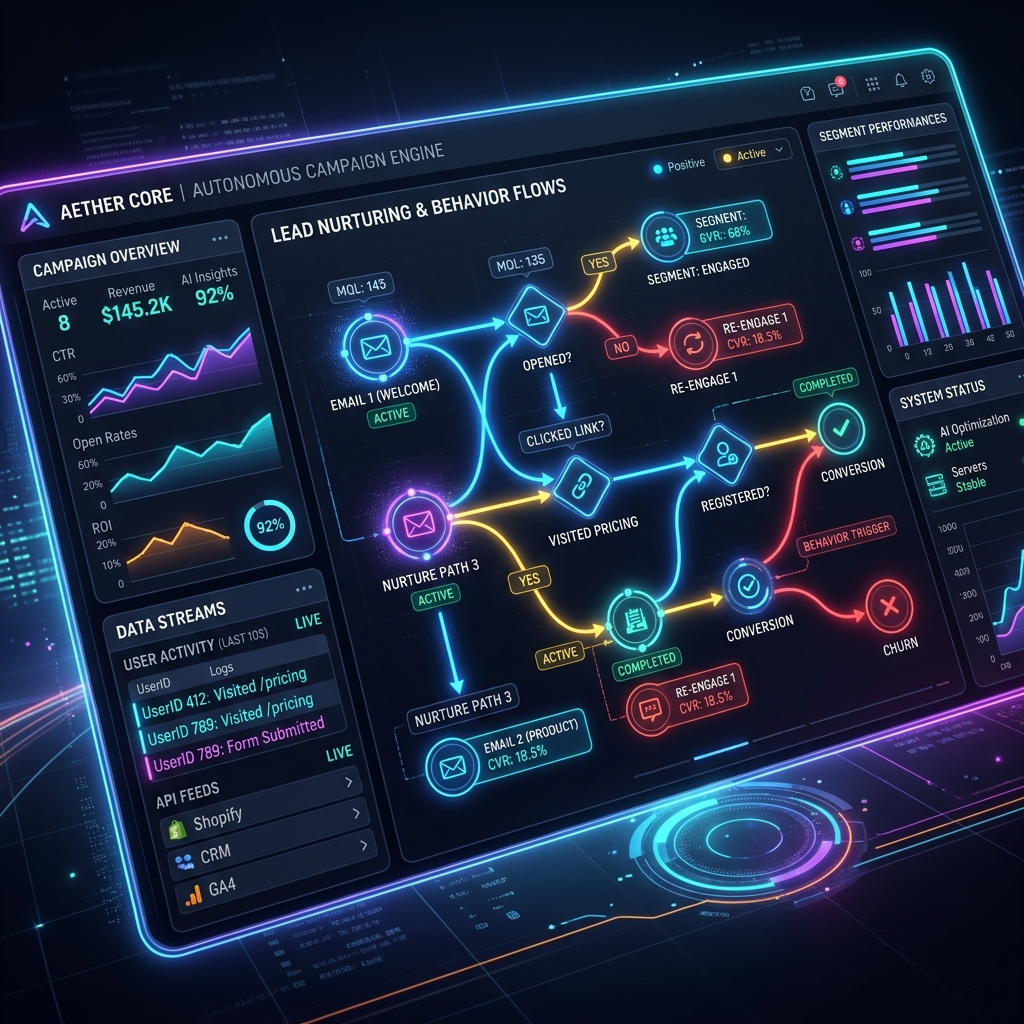
Step 1: Connect Your Intent Signals
To nurture effectively, your AI agents must know when a prospect is active.
- The Tactic: Connect your CRM, web analytics, and product usage data to the Vect AI Market Signal Analyzer. This establishes the core data stream that triggers the nurturing flows.
Step 2: Establish the Knowledge Repository
Your agents need access to your company’s case studies, product documentation, and value propositions.
- The Tactic: Upload your marketing assets into the Vect AI platform. The AI enriches these documents and saves them to your brand's vector index, making them instantly accessible for dynamic email personalization.
Step 3: Configure the Email Outreach Flow
Use the Marketing Email module to set up your domain and sender settings.
- The Tactic: Enable automatic inbox rotation and warm-up features to protect your deliverability. Set boundaries for email volume and frequency to avoid overloading prospects.
Step 4: Launch the AI Writer Agent
Set up the parameters for your automated copywriter.
- The Tactic: Define your brand voice guidelines. Instruct the agent to keep emails brief, conversational, and direct, concluding each email with a single, clear call-to-action.
Best Practices for B2B SaaS Nurturing in 2026
To achieve high conversion rates, keep the following principles in mind when building your flows:
- Lead with Value, Not Pitching: Do not use the first email to ask for a meeting. Instead, provide a free resource, a relevant case study, or a custom audit that addresses a challenge they are currently facing.
- Maintain Strict Quality Controls: Even if the copywriting is fully automated, implement validation steps to check for formatting errors and verify that links resolve correctly before sending.
- Monitor Inbox Reputation: Rotate your sending domains and keep your bounce rate below 1% to ensure your personalized emails consistently land in the primary inbox.
The AI Nurturing Setup Checklist
Review this checklist before activating your campaign:
[ ]Integration Check: Verify that CRM webhook integrations are sending visitor data to the workspace.[ ]Knowledge Grounding: Confirm that the RAG index contains up-to-date pricing sheets and case studies.[ ]Inbox Reputation: Warm up any new domains for at least 14 days before enrolling high-volume campaigns.[ ]Personalization Check: Run test emails for 5 different buyer personas to verify the quality of the generated copy.[ ]Opt-Out Compliance: Ensure all emails contain a functional, one-click unsubscribe link to maintain sender compliance.
Conclusion
Traditional, generic outbound and nurture playbooks are no longer enough to build a reliable pipeline in the B2B SaaS ecosystem. By moving to autonomous, intent-triggered nurturing workflows, you ensure that every prospect receives timely, relevant value, accelerating their journey from discovery to demo.
Ready to automate your lead conversion?
Log into your Vect AI command center, open the Marketing Email tab, and configure your first autonomous nurture sequence today.
Stop Reading. Start Scaling.
You have the blueprint. Now you need the engine. Access the full Vect AI Platform and get results in minutes.
Access Dashboard