
The content treadmill is officially broken. It is time to replace it with autonomous operations.
In 2026, organic growth is no longer a game of keyword quantity or manual assembly lines. With search platforms transitioning into answer engines (like Perplexity and ChatGPT Search) and search engines implementing strict utility filters, the old model of content marketing has collapsed. Pumping out low-quality AI drafts or hiring a massive team of human writers to manually script articles is either too dangerous or too slow.
To maintain visibility, build authority, and scale traffic in this new paradigm, companies are shifting to Agentic Content Operations.
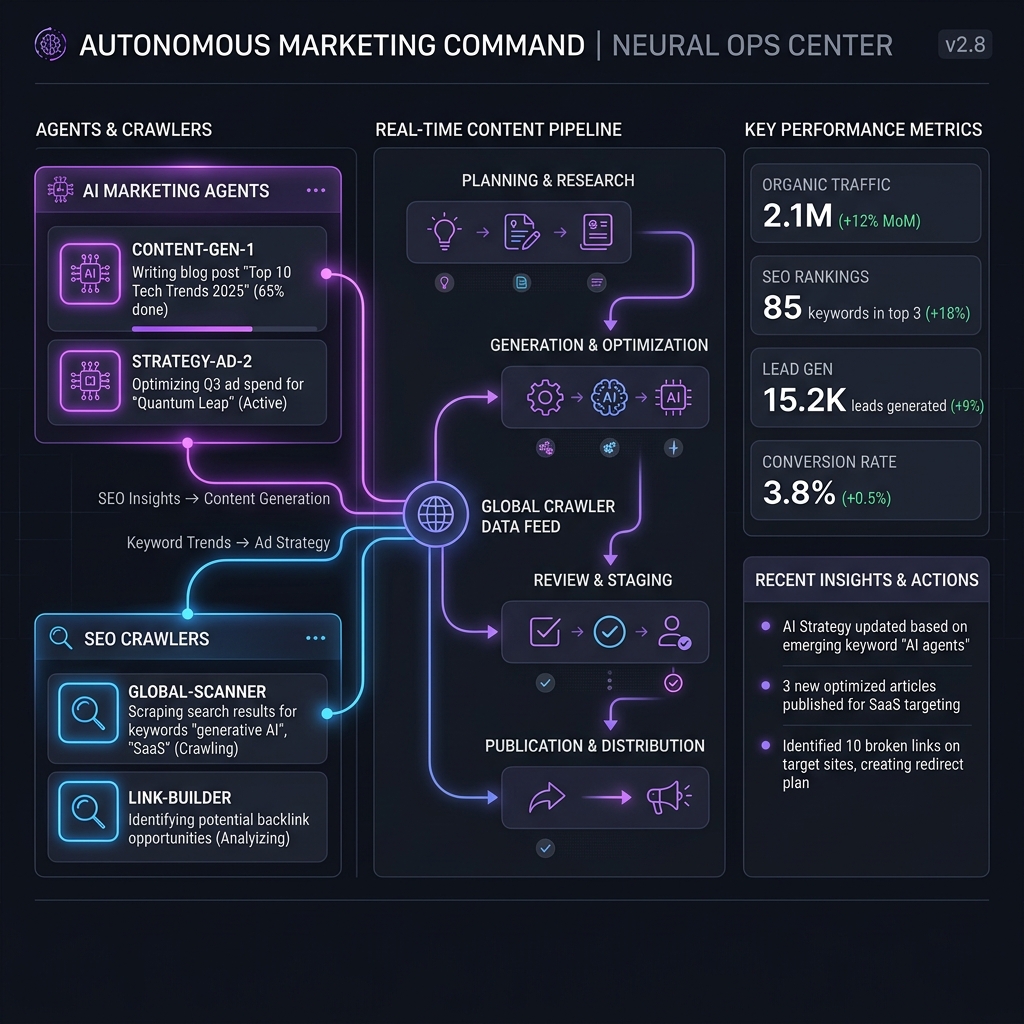
Rather than relying on simple, single-prompt AI generators that yield generic results, Agentic Content Operations deploys a coordinated ecosystem of autonomous, role-specific AI agents. These agents research, outline, write, edit, and optimize articles in closed-loop systems, producing expert-level content at a fraction of the traditional cost.
In this guide, we will examine the architecture of Agentic Content Operations and demonstrate how to deploy your own system using the Vect AI Platform.
What is Agentic Content Operations?
Agentic Content Operations is the systemized coordination of autonomous AI agents working collaboratively to plan, research, produce, audit, and distribute content.
Unlike traditional marketing automation, which relies on rigid "If-This-Then-That" pipelines, agentic systems use Large Language Models (LLMs) to reason and make decision-making loops. They don't just write text; they research live sources, verify factual accuracy against your company knowledge base, audit drafts for brand alignment, and structure the resulting code for search crawlers.
Standard AI Writing vs. Agentic Content Operations
The difference between basic generative tools and true agentic operations is massive:
- Standard AI Writing: A user inputs a single prompt (e.g., "Write a blog post about SEO"). The LLM generates a single output in one pass. The content is often generic, lacks depth, contains hallucinations, and requires heavy human editing.
- Agentic Content Operations: A central orchestrator assigns sub-tasks to specialized agents. The Researcher Agent scrapes the web; the Planner Agent designs a detailed content outline; the Writer Agent drafts the copy; the Fact-Checker Agent validates statistics; the Editor Agent enforces brand voice; and the SEO Agent optimizes headings and schema markup. The final output is high-utility, accurate, and completely aligned with search intent.
The Multi-Agent Production Pipeline
An optimized agentic content network acts like an agile digital marketing team. By assigning specific personas and boundaries to each agent, you prevent generic outputs and ensure strict quality control.
Here is the blueprint of a standard multi-agent content pipeline:
graph TD
    A[Campaign Objective Defined] --> B[Researcher Agent: Scrapes Web & RAG Data]
    B --> C[Strategist Agent: Generates Detailed Outline]
    C --> D[Writer Agent: Drafts High-Density Copy]
    D --> E[Fact-Checker Agent: Verifies Data & Statistics]
    E --> F[Editor Agent: Aligns Brand Voice & Style]
    F --> G[SEO Optimizer: Injects Headers & Schema]
    G --> H[Final Review: Human-in-the-Loop Approval]
1. The Researcher Agent (Information Gathering)
The Researcher scans search engine results, competitor structures, and internal documentation. It extracts primary data, recent industry statistics, and verified facts. This ensures the content is backed by real-world data rather than outdated training data.
2. The Strategist Agent (Outline & Structure)
The Strategist structures the content layout. It defines the heading hierarchy (H2s and H3s), mapping them directly to search intent and the conversational queries users ask AI answer engines.
3. The Writer Agent (Drafting & Flow)
The Writer takes the structured outline and researched facts, translating them into highly engaging, informative copy. Because the Writer is focused strictly on writing (and not research or formatting), it can concentrate on sentence variety, readability, and logic.
4. The Fact-Checker Agent (Accuracy Assurance)
The Fact-Checker compares every claim and statistic in the draft against the research files. If it detects a hallucination, an unverified percentage, or an inaccurate date, it flags the sentence and sends it back to the Writer with specific correction instructions.
5. The Editor Agent (Brand Voice Enforcement)
The Editor evaluates the style, tone, and formatting of the draft. It adjusts vocabulary to match the target audience and ensures the content aligns with your brand voice guidelines.
6. The SEO Optimizer (Search Engine & GEO readiness)
The SEO Optimizer reviews keyword density, ensures the first 100 words contain the "definition hook" for AI retrieval, structures tables, builds the FAQ section, and generates the necessary JSON-LD structured schema.
Traditional Content Operations vs. Agentic Content Operations
To understand the business value of transitioning to an agentic framework, we can compare the operational metrics of traditional human/hybrid teams with autonomous agent pipelines:
| Metric | Traditional Human Team | Single-Prompt AI | Agentic Content Operations |
|---|---|---|---|
| Production Speed | 1–3 days per article | 5 minutes per article | 30 minutes per article |
| Research Grounding | High (Human analysis) | Low (Outdated training data) | Very High (Real-time web scraping) |
| Fact-Checking | Manual (Time-consuming) | None (High hallucinations) | Automated & Loop-validated |
| Topical Coverage | Slow to scale | Fast but repetitive | Fast, diverse, and structured |
| Unit Cost | $150–$500 per article | $0.10 per article | $2.00–$5.00 (API & Credit costs) |
| E-E-A-T Quality | High | Low | High (Structured & Factual) |
Step-by-Step Guide to Deploying Agentic Operations
Here is the exact playbook to move from manual content generation to an autonomous marketing engine using Vect AI.
Step 1: Centralize Your Brand Voice
Autonomous agents require a baseline context to understand your product, audience, and style.
- The Tactic: Upload your style guides, whitepapers, and target persona profiles into the Vect AI platform. The system vectorizes this knowledge, ensuring all participating agents reference the same core guidelines.
Step 2: Establish the Keyword Cluster
Before launching agents, you need to map out your topical authority goals.
- The Tactic: Use the SEO Content Strategist to identify high-intent keyword gaps. The tool will group keywords into clusters, ensuring your content covers the entire customer journey.
Step 3: Configure the Orchestration Workflow
Set up the workflow using the Campaign Builder to connect your research, generation, and editing agents.
- The Tactic: Define the exact validation loops. For example, instruct the Fact-Checker agent to automatically reject any draft that contains unreferenced statistics or generic jargon.
Step 4: Run the Quality Audit
Once the agents complete a draft, it goes to the review stage.
- The Tactic: Use the human-in-the-loop review interface to verify the final layout. Check that it contains a comparison table, structured key takeaways, and clear header elements.
Best Practices for Agentic SEO and GEO
Writing content for both traditional search engine crawlers and conversational AI engines requires strict formatting guidelines. Ensure your agentic setups adhere to the following principles:
- Direct Answers First: Place a concise 2–3 sentence answer directly beneath your main H2 headers. AI engines search for these specific definition snippets when compiling conversational search summaries.
- Provide Structured Comparisons: Always include markdown tables comparing key concepts. Structured tables are highly readable for humans and are easily ingested by LLMs.
- Incorporate Dynamic Freshness: Update your content regularly with real-time statistics. Older, stale content is ignored by engines that value real-time citations. Use Vect AI's freshness loops to automate these updates.
The Agentic Content Operations Checklist
Before publishing your content, verify that your campaign configuration checks every box:
[ ]Context Grounding: Ensure your Researcher Agent is connected to updated web APIs or target database files.[ ]Fact-Verification Loop: Confirm that drafts are audited by a separate validation agent before reaching the human reviewer.[ ]Schema Generation: Verify that the output includesBlogPostingandFAQPageschema metadata.[ ]Internal Link Architecture: Ensure the Planner Agent automatically identifies relevant internal links to build structural topic clusters.[ ]Utility Score Audit: Edit out passive phrasing and repetitive definitions. Every paragraph must provide distinct, educational value.
Conclusion
The future of content marketing belongs to organizations that can build, scale, and optimize their search footprint without multiplying their operational overhead. By deploying an ecosystem of autonomous agents to handle the research, drafting, editing, and technical optimization of your articles, you ensure your brand dominates the organic channels of tomorrow.
Ready to build your autonomous content engine?
Log into your Vect AI dashboard, open the Campaign Builder, and launch your first multi-agent content campaign today.
Stop Reading. Start Scaling.
You have the blueprint. Now you need the engine. Launch the AI agent for "SEO Content Strategist" and get results in minutes.
Launch SEO Content Strategist