
If your sales team is still blasting cold email lists based purely on job titles, you are burning capital and ruining your domain reputation.
In 2026, successful B2B growth teams have abandoned volume-based prospecting. Instead, they rely on Signal-Based Selling—the process of initiating highly relevant conversations triggered by real-time events.
By shifting your focus from "how many emails can we send" to "why are we reaching out today," you ensure your messages land in the primary inbox and resonate with the buyer's current priorities.
In this guide, we break down the core buying signals, map out a signal-led outbound workflow, and show you how to execute this strategy using Vect AI.
What is a Buying Signal?
A buying signal is an event or data point indicating that a company has a higher-than-average likelihood of needing your product or service right now.
Instead of waiting for prospects to fill out a demo form (inbound), you actively monitor these triggers to launch timely, personalized outbound campaigns.
Comparison of Key Buying Signals
Here is a breakdown of the most common sales signals and how to operationalize them:
| Trigger Event | What It Signals | Best Outreach Hook Angle |
|---|---|---|
| New Executive Hire | Budget changes and strategy shifts | "Congrats on the role—here is how we help new leaders transition." |
| Hiring Spikes | Team expansion and operational bottlenecks | "Saw you're scaling your sales team—how are you handling onboarding?" |
| Recent Funding | Capital budget availability | "Congrats on the Series A—let's scale your acquisition infrastructure." |
| Technographic Changes | Adopting or dropping a competitor tool | "Saw you recently installed [Competitor]—here is a simpler alternative." |
The Signal-Led Outbound Workflow
To execute signal-based selling at scale, you need a system that monitors, enriches, and acts on signals automatically.
Here is the exact workflow managed by Vect AI:
graph TD
    A[Monitor Web & Job Boards] --> B[Identify Relevant Trigger Signal]
    B --> C[Validate Lead & Contact Info]
    C --> D[Generate Custom Hook via Resonance Engine]
    D --> E[Deliver Personalized Outreach]
1. Continuous Monitoring
Vect AI's Market Signal Analyzer scans social signals, news cycles, and job boards to detect companies experiencing operational shifts.
2. Immediate Enrichment
Once a trigger is validated, the agent automatically enriches the account details to find the decision-maker associated with the challenge (e.g., matching a "scaling engineering team" signal with the VP of Engineering).
3. Hyper-Tailored Copy
The agent uses the hook to write a short, highly personalized email that links the event to your value proposition, ensuring zero generic filler copy.
Implementing Signal-Based Outbound with Vect AI
Here is how to set up your first signal-led campaign:
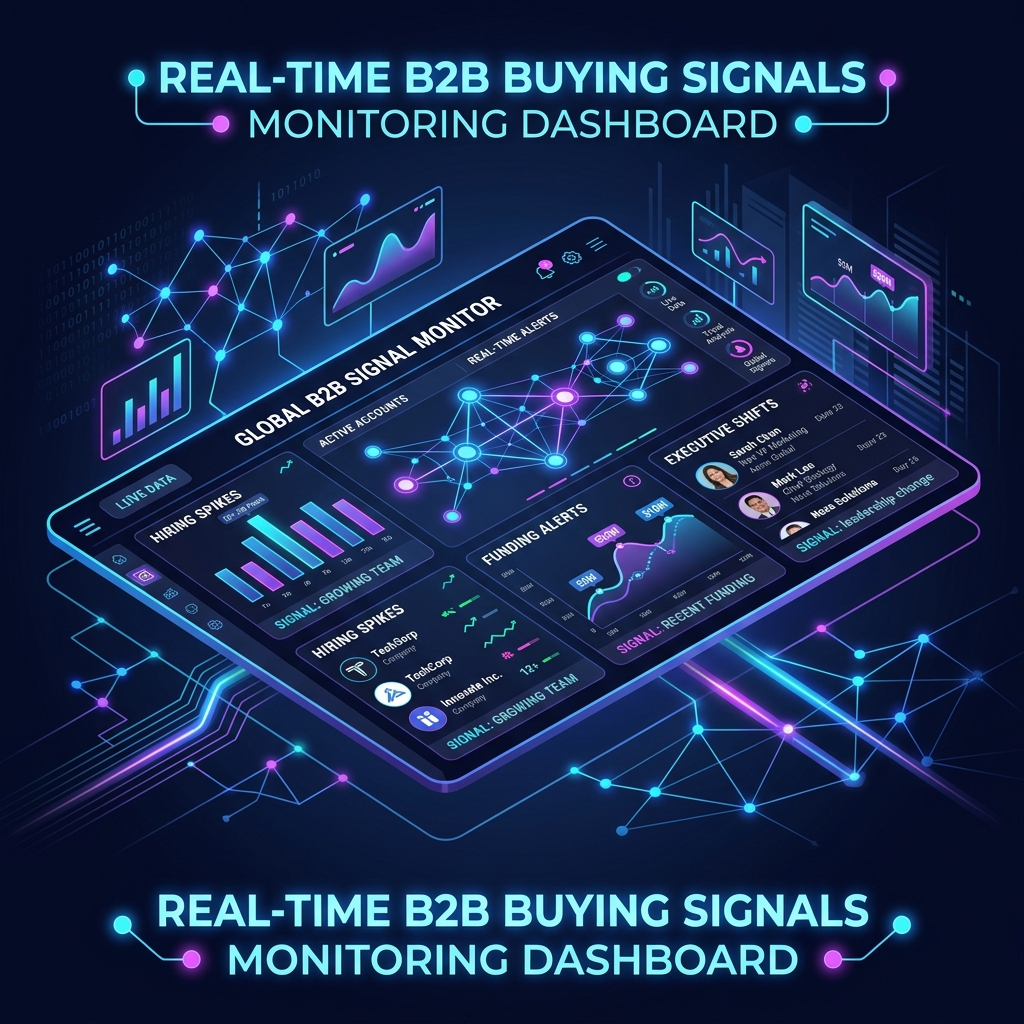
Step 1: Define Your Target Triggers
Identify which signals correlate highest with your product's value. For example, if you sell marketing software, a "new CMO hire" or a "decline in organic traffic" is your perfect trigger.
Step 2: Set Up the Market Signal Analyzer
Configure Vect's Market Signal Analyzer to monitor these specific events for your target accounts.
Step 3: Map Triggers to Copy Angles
Ensure your Marketing Email templates are mapped to each signal. A funding signal requires a growth-oriented angle, while a hiring signal requires an efficiency-oriented angle.
Conclusion
Outbound sales in 2026 is a game of timing and context. By implementing a signal-based selling motion, you stop guessing who to pitch and start targeting companies when they are most receptive to your message.
Ready to automate your signal-led sales pipeline?
Log into Vect AI, open the Market Signal Analyzer, and launch your first signal-based campaign today.
Stop Reading. Start Scaling.
You have the blueprint. Now you need the engine. Launch the AI agent for "Market Signal Analyzer" and get results in minutes.
Launch Market Signal Analyzer