
In 2026, the businesses that scale are not those with the largest marketing budgets, but those with the smartest autonomous marketing operations.
The transition from traditional, rule-based marketing automation to autonomous, agentic workflows has completed. Companies are no longer manually setting up complex if-then branching trees in old-school CRMs. Instead, they are deploying autonomous AI marketing automation tools that reason, plan, execute, and self-correct to drive exponential business and social media growth.
At the center of this revolution is Vect AI, an all-in-one marketing operating system that enables companies to run highly complex campaigns on autopilot. By coordinating networks of specialized AI agents, Vect AI bridges the gap between raw data and high-converting marketing execution.
In this guide, we will explore the core benefits of deploying AI marketing automation tools, detail how they accelerate business and social media growth, highlight the key features of the Vect AI platform, and provide a clear framework for launch.
The Evolution of Marketing Automation: Why Rule-Based Systems Failed
To understand the power of modern AI marketing automation tools, we must look at why previous-generation automation systems failed to scale. Traditional systems like HubSpot or Marketo rely on static, human-defined rules.
If a user downloads an e-book, send Email A. If they don't open it in three days, send Email B.
This model has several critical limitations:
- High Maintenance: Marketers spend hundreds of hours building, testing, and debugging complex automation workflows.
- Lack of Context: Traditional systems cannot read between the lines. They do not know why a customer did not open an email, nor can they dynamically rewrite the content to make it more appealing to that specific individual.
- Template Fatigue: Automated emails and social posts look and feel automated. Audiences in 2026 can spot generic, template-driven copy instantly, leading to plummeted conversion rates.
Autonomous AI tools solve this by replacing rigid trees with dynamic reasoning loops. Instead of prescribing every step, you define a goal (e.g., "Acquire 50 demo bookings from enterprise security leaders"), and the AI determines the optimal path, researching prospects, writing personalized copy, and adjusting the campaign based on real-time feedback.
Core Benefits of AI Marketing Automation for Business Growth
Deploying autonomous marketing tools directly impacts your bottom line. By removing operational friction and executing at infinite scale, AI agents transform how businesses acquire and nurture customers.
1. Unified Multi-Channel Campaign Orchestration
The primary bottleneck in modern marketing is fragmentation. A single campaign often requires coordination across blog posts, newsletters, landing pages, paid search, and social channels.
With the Vect AI Campaign Builder serves as your command center. You input a single campaign objective, and the agent orchestrates the entire workflow. It maps out the content strategy, generates the blog posts, designs landing pages, and drafts email outreach. This unified approach eliminates silos and ensures a consistent message across every touchpoint.
2. High-Intent B2B Lead Generation
Manual list-building and generic outbound emailing are relics of the past. Modern B2B growth relies on signal-based automation.
By combining the AI Lead Generation system with the Signal-Based Selling Guide, Vect AI agents monitor real-time public data sources—such as hiring boards, financial reports, executive hires, and social media announcements. When a target account triggers a buying signal (e.g., hiring a new VP of Marketing or expanding into a new region), the agent instantly drafts a hyper-personalized email referencing the specific signal and explaining how your product solves their current challenges.
3. Real-Time Conversion Optimization
A major cause of wasted marketing spend is a leaky conversion funnel. Most websites and landing pages are static, presenting the same content to every visitor regardless of their background or intent.
AI-native agents continuously audit your funnels. Using tools like the AI Landing Page Roaster and Conversion Killer Detector Guide, agents analyze visitor scroll maps, click-through rates, and bounce patterns. The agent then runs real-time A/B tests on headline copy, call-to-action buttons, and form lengths, automatically implementing the highest-performing variation to maximize conversion rates.
Core Benefits of AI Marketing Automation for Social Media Growth
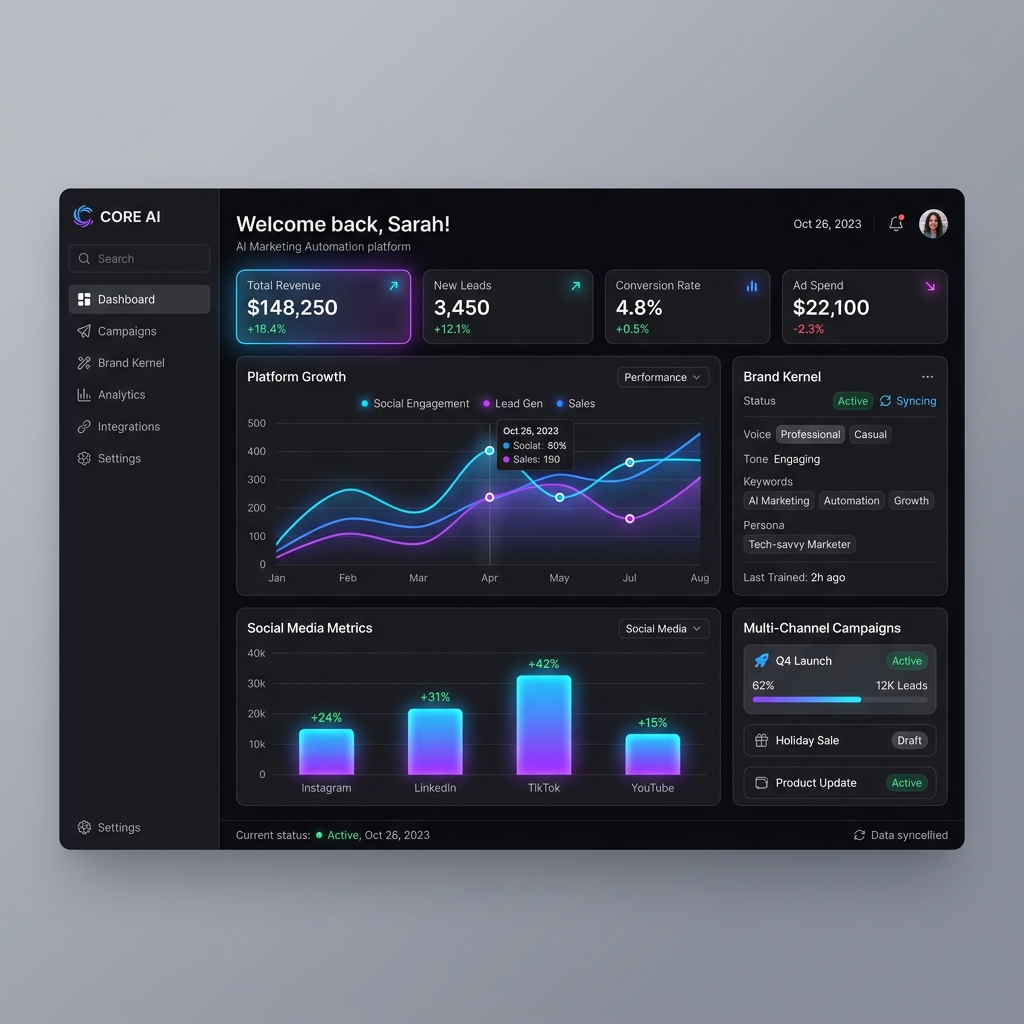
Establishing brand authority on social media requires high frequency, platform-specific formatting, and rapid response to trends. Doing this manually across LinkedIn, Twitter/X, and YouTube is impossible for lean teams. AI automation acts as a 24/7 social media agency.
1. Dynamic Content Adaptation
A common mistake is copy-pasting the same post across different social channels. Each platform has its own unique culture, format constraints, and algorithmic preferences.
AI agents solve this by automatically translating core business concepts into customized, platform-specific formats:
- LinkedIn: The AI LinkedIn Post Generator drafts authoritative, story-driven posts tailored for professional audiences, complete with bulleted takeaways and engagement-starting questions.
- Twitter/X: The AI Twitter Thread Generator converts the same core concept into a punchy, high-retention thread designed to maximize shares and bookmarks.
- Short-Form Video: The AI Viral Video Script Generator outlines high-impact video scripts and blueprints for TikTok or YouTube Shorts, which are then routed to the AI Video Ads engine for rapid creation.
2. Hacking Trends with Market Signals
The fastest way to achieve organic social growth is to participate in trending topics before they become saturated.
The Market Signal Analyzer monitors search engines, news publications, and social media trends in real-time. When a relevant topic starts gaining traction in your industry, the agent alerts the team and drafts a response post that incorporates your company's unique value proposition. This allows your brand to ride waves of viral interest, driving massive, high-intent traffic back to your site.
3. Absolute Brand Voice Control
The biggest concern with scaling content using AI is the risk of off-brand outputs or hallucinated facts. A single off-tone post can damage years of built trust.
Vect AI mitigates this through its patented Brand Voice Architecture. Before any agent writes a single word of copy, it references the Brand Kernel—a secure repository containing your style guidelines, brand dictionary, approved case studies, and compliance constraints. The Brand Kernel agent acts as a final editorial gate, reviewing all content to ensure it aligns perfectly with your established voice before publication.
Behind the Scenes: The Autonomous Multi-Agent Campaign Flow
To understand how these benefits materialize, let us look under the hood of a typical multi-agent marketing campaign in Vect AI. Rather than relying on a single, monolithic model, Vect AI coordinates a team of specialized agents:
graph TD
    Brief[User Inputs Campaign Brief] --> Orchestrator[Orchestrator Agent]
    Orchestrator --> Researcher[Researcher Agent: Analyzes Market Signals]
    Orchestrator --> SEOAgent[SEO Agent: Develops Semantic Clusters]
    Researcher --> Writer[Copywriting Agent: Drafts Blogs & Social Posts]
    SEOAgent --> Writer
    Writer --> Visualizer[Visual Agent: Generates Charts & UI Assets]
    Writer --> Compliance[Brand Kernel Agent: Verifies Voice & Rules]
    Visualizer --> Compliance
    Compliance -->|Fails Review| Writer
    Compliance -->|Passes Review| Publisher[Deployment Agent: Schedules & Publishes]
    Publisher --> Analyst[Analytics Agent: Monitored Conversions]
    Analyst -->|Feedback Loop| Orchestrator
The Campaign Blueprint in Action
- Strategic Outline: The user enters a brief in the Campaign Builder (e.g., "Announce our new B2B integrations to SaaS founders").
- Deep Market Research: The Researcher agent scrapes Google and competitor sites to identify current industry pain points.
- Keyword Optimization: The SEO agent builds a semantic map of high-intent keywords to target.
- Drafting and Visualization: The Copywriter agent writes the content, while the Visual agent generates matching diagrams and charts using the AI Image Studio Guide.
- Quality Assurance: The Brand Kernel agent checks the drafts. If the tone is too casual or contains unapproved terms, it sends it back to the Copywriter agent with specific edit instructions.
- Publishing and Analysis: Once approved, the Deployment agent publishes the article to the blog, updates the sitemap, and schedules social media updates. The Analytics agent tracks conversion performance and feeds it back to the Orchestrator to optimize future campaigns.
SEO Guidelines & Checklist for Autonomous Content in 2026
To rank highly on search engines and ensure your content is recommended by AI search engines (like ChatGPT Search, Claude, and Perplexity), follow this technical checklist for every post:
1. Optimize for Generative Engine Extraction (GEO)
AI search engines do not just look at keywords; they summarize content for users. Make your site easy for them to parse:
- Direct Answers: Place a concise 2-sentence summary of the main topic within the first 100 words.
- Comparison Frameworks: Use markdown tables to compare strategies, features, or tools.
- Structured Lists: Use step-by-step numbered lists for tutorials and workflows.
2. Build Topical Authority with Internal Links
Ensure your content is well-integrated within your site's ecosystem. Link back to related resources, such as the Agentic Content Operations Guide, the Autonomous AI Nurture Flows article, and the GEO strategies guide.
3. Maintain Metadata Precision
Verify your page settings before publishing:
- Title Tag: Must be between 55 and 60 characters.
- Slug/Permalink: Must be descriptive and between 70 and 75 characters.
- Meta Description: Must be between 120 and 160 characters.
Step-by-Step Guide to Deploying Your First Campaign with Vect AI
Deploying your first autonomous campaign is straightforward and requires no technical expertise:
Step 1: Initialize Your Brand Kernel
Log into your Vect AI dashboard and upload your brand documentation, style guides, and customer testimonials. This builds your unique Brand Kernel, securing your brand voice across all outputs.
Step 2: Model Your Buyer Persona
Use the Simulate Buyer Persona Guide to create virtual replicas of your target customers. This allows you to test content and messaging resonance before launching campaigns.
Step 3: Run Content Gap Analysis
Run the AI Content Gap Finder against your top three competitors. The tool will identify high-intent keywords they rank for that you are missing, and generate content drafts to target them.
Step 4: Configure the Campaign Builder
Navigate to the Campaign Builder, select your channels (Blog, LinkedIn, Twitter/X), set your target keyword (e.g., "AI marketing automation tools"), and launch the multi-agent generation loop.
Step 5: Final Editorial Review
Review the generated drafts, verify compliance using the Brand Kernel suggestions, and click Publish to push your content live.
Supercharge Your Growth with Autonomous Tools
Relying on manual workflows and disconnected platforms limits your company's growth potential. By integrating autonomous AI marketing automation tools into your operations, you build a scalable marketing engine that works 24/7.
Ready to start scaling?
Sign up for Vect AI, define your campaign goals, and launch your first coordinated agent network today.
Stop Reading. Start Scaling.
You have the blueprint. Now you need the engine. Launch the AI agent for "Campaign Builder" and get results in minutes.
Launch Campaign Builder