The marketing playbook is being rewritten in 2026, and traditional software stacks are no longer enough to win.
Modern marketing departments face an overwhelming challenge: managing dozens of fragmented tools, creating infinite streams of channel-specific content, tracking shifting algorithms, and trying to capture high-intent leads. To solve this, leading organizations are transitioning from simple automation to autonomous AI-native marketing agents.
These intelligent agents do not just execute predefined tasks; they reason, plan, research, and self-correct. By deploying a coordinated network of AI-native agents through platforms like Vect AI, companies are eliminating operational bottlenecks, driving massive B2B growth, and scaling their social media presence in ways that were previously impossible.
In this comprehensive guide, we will unpack how AI-native marketing agents work, explore the massive benefits they bring to business and social media growth, and provide a step-by-step framework to launch your own autonomous marketing system today.
What Are AI-Native Marketing Agents?
To appreciate this technological shift, we must define what makes an agent "AI-native." Unlike legacy marketing automation systems that rely on strict workflows and APIs to send emails or post pre-scheduled updates, AI-native agents operate with goal-oriented autonomy.
You provide the agent with a destination (e.g., "Increase signups for our SaaS product among mid-market product managers"), and the agent figures out the path to get there. It will search the web, study competitor positioning, determine the optimal keywords, write the copy, create visual assets, and deploy the campaigns.
Key Pillars of Agentic Marketing Operations
- Autonomy: Agents make decision-paths on their own based on the high-level objectives you define.
- Reasoning: Powered by advanced reasoning models, they analyze performance and adjust their prompts and strategies.
- State Management: They maintain context across multi-step, multi-day marketing workflows.
- Collaboration: Multiple specialized agents can coordinate, passing tasks from one to another (e.g., a researcher agent passing data to a copywriter agent, which then passes the draft to a compliance agent).
Traditional Automation vs. AI-Native Marketing Agents
Before diving into the benefits, let us compare how traditional automation stacks match up against autonomous agent networks:
| Operational Metric | Traditional Marketing Automation | AI-Native Marketing Agent Networks |
|---|---|---|
| Logic & Structure | Static rules, rigid workflows, and webhooks | Dynamic reasoning, planning, and goal execution |
| Content Quality | Template-based, repetitive, and dry | Human-grade, hyper-personalized, and adaptive |
| Research Capability | None; requires manual input from marketers | Real-time web scraping, trend hacking, and analysis |
| Asset Diversity | Text only or stock image templates | Dynamic custom designs, high-converting copy, and video |
| Scale Constraint | Limited by human review and setup time | Virtually infinite, limited only by API rate limits |
| Optimization Loop | Manual A/B test setup and analysis | Self-reflection, automated adjustments, and learning |
Core Benefits of AI Marketing Automation for Business Growth
Deploying AI-native agents into your marketing engine is the single most effective way to accelerate business growth in 2026. Here is why:
1. Unified Campaign Orchestration
Instead of bouncing between keyword tools, email platforms, and ad managers, the Vect AI Campaign Builder serves as your command center. You input a single campaign objective, and the agent orchestrates the entire workflow. It maps out the content strategy, generates the blog posts, designs landing pages, and drafts email outreach. This unified approach eliminates silos and ensures a consistent message across every touchpoint.
2. High-Intent Lead Generation at Scale
Traditional lead generation involves manually building lists and sending cold outreach. AI agents revolutionize this through signal-based triggers. By integrating the AI Lead Generation Guide and the Signal-Based Selling Guide, agents can scan job boards, press releases, and funding announcements. When a target company exhibits a buying signal, the agent immediately constructs a hyper-personalized email tailored to their exact pain point, increasing reply rates exponentially.
3. Precision Competitive Positioning
Staying ahead of competitors requires constant vigilance. AI agents can monitor competitor websites, pricing pages, and product launches in real-time. Using the Competitor Strategy Spy tool, the agent identifies content gaps and suggests positioning adjustments. It then feeds this information back into your campaign workflows, ensuring your messaging always highlights your unique advantages.
4. Dynamic Funnel Optimization
Most landing pages and sales funnels are static, presenting the same message to every visitor. AI-native agents run continuous diagnostic checks on your conversion funnels. With tools like the AI Landing Page Roaster and Conversion Killer Detector Guide, agents analyze user behavior, identify friction points, and rewrite copy or adjust layouts to maximize signups and sales automatically.
Core Benefits of AI Marketing Automation for Social Media Growth
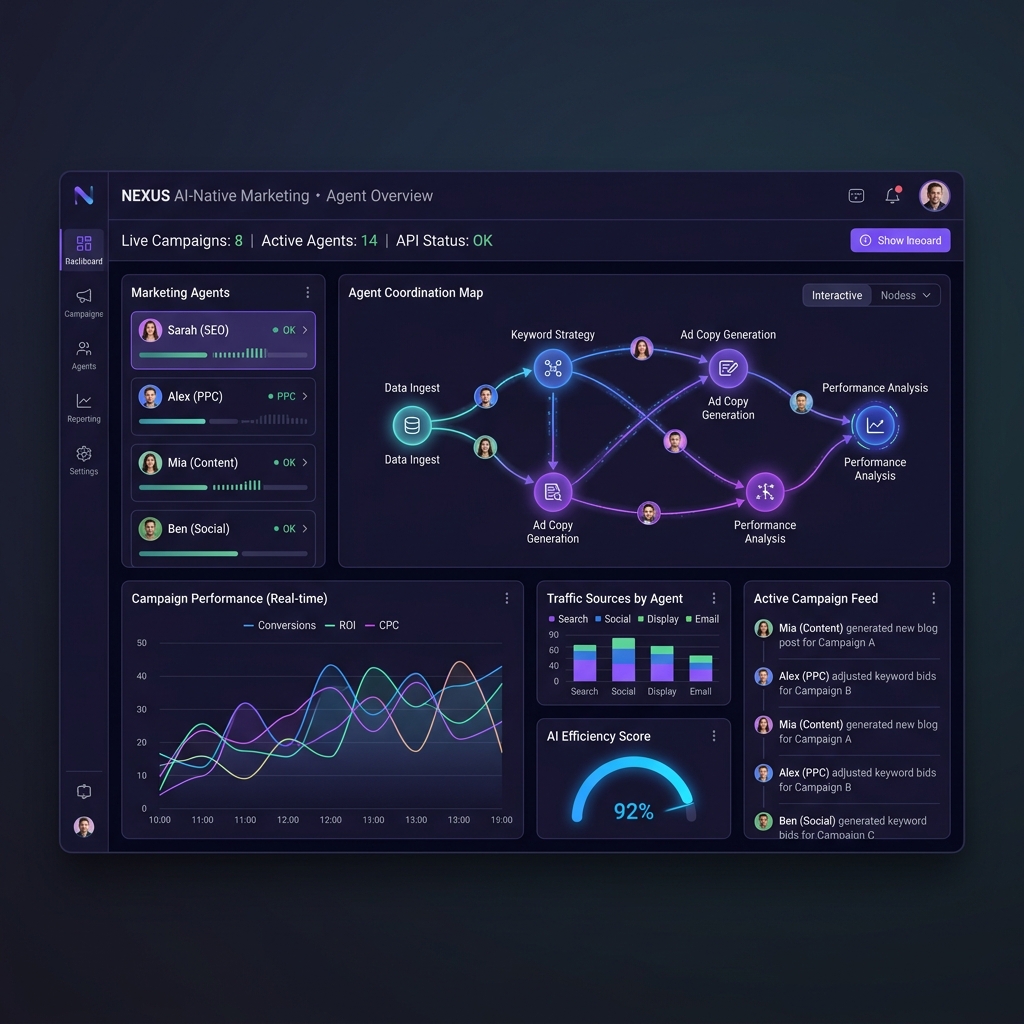
Building a dominant brand presence on social media requires consistency, speed, and visual appeal. AI-native agents act as a dedicated social media agency working around the clock.
1. Scaling Platform-Specific Content Loops
Writing content that resonates on LinkedIn requires a different style than creating threads for Twitter/X or scripts for YouTube. AI agents excel at translating core concepts into multiple formats. By coupling the AI LinkedIn Post Generator with the AI Twitter Thread Generator, you can input a single research paper or case study and receive a week's worth of highly optimized social media posts tailored to each platform's unique algorithm.
2. Real-Time Trend Hacking and Newsjacking
The fastest way to grow organically is to participate in trending industry conversations. The Market Signal Analyzer continuously monitors social feeds, search engines, and news outlets. When a trending topic aligns with your business niche, the agent drafts a highly relevant post incorporating your perspective, allowing you to ride the wave of viral traffic before your competitors even notice the trend.
3. Automated Short-Form Video Creation
Video is the highest-performing content format on social media, but it is also the most time-consuming to produce. AI agents streamline the video production pipeline. The AI Viral Video Script Generator creates high-retention hooks and step-by-step video blueprints, while the AI Video Ads Guide helps translate those scripts into completed video ads and social reels, driving massive engagement on TikTok, Instagram, and YouTube.
4. Cohesive Brand Voice Management
The biggest risk of scaling content with AI is losing your brand's unique identity. Vect AI solves this through the Brand Voice Architecture. You define your brand's tone, vocabulary, and values in the Brand Kernel. Every piece of social media content generated by the agents is automatically reviewed to ensure it aligns perfectly with your established guidelines, protecting your brand equity.
Behind the Scenes: The Multi-Agent Orchestration Workflow
How do these agents coordinate in real-time? Let us examine the exact multi-agent architecture that Vect AI uses to launch and optimize a marketing campaign:
graph TD
    UserGoal[User Inputs Campaign Goal] --> Orchestrator[Orchestrator Agent: Outlines Campaign]
    Orchestrator --> Research[Research Agent: Scrapes Web & Competitors]
    Research --> SEO[SEO Agent: Identifies Keywords & Semantic Clusters]
    SEO --> Writer[Copywriting Agent: Drafts Blogs & Social Posts]
    Writer --> Designer[Visual Agent: Generates Diagrams & Infographics]
    Designer --> Compliance[Brand Kernel Agent: Verifies Voice & Compliance]
    Compliance -->|Fails Check| Writer
    Compliance -->|Passes Check| Deploy[Deployment Agent: Publishes to Web & Social]
    Deploy --> Analytics[Analytics Agent: Monitors Conversions & CTR]
    Analytics -->|Feeds Performance Data| Orchestrator
The Step-by-Step Execution Loop
- Goal Setup: The user enters an objective in the Campaign Builder (e.g., "Promote our AI newsletter tool to marketing directors").
- Strategic Outlining: The Orchestrator agent breaks the goal down into tasks: keyword research, blog creation, visual asset creation, and social distribution.
- Real-Time Research: The Research agent scrapes current search trends and competitor posts to find high-traffic angles.
- Content Drafting: The Copywriting agent writes a 2,000-word blog post, while the Visual agent generates high-quality diagrams using the AI Image Studio Guide.
- Compliance Filter: The Brand Kernel agent checks the draft against your brand style guidelines. If it fails, it provides feedback to the writer agent for a revision.
- Autonomous Launch: Once approved, the Deployment agent pushes the blog post to your site, schedules social media posts, and sets up email flows.
- Performance Feedback: The Analytics agent tracks click-through rates (CTR) and conversions, feeding the insights back to the Orchestrator to optimize the next campaign.
SEO Guidelines & Checklist for Blog Posts in 2026
To ensure your blog posts rank highly on Google and get cited by AI answer engines like ChatGPT, Claude, and Gemini, implement the following checklist for every piece of content you publish:
1. Target Transactional & High-Intent Keywords
Do not target keywords based solely on search volume. Focus on high-intent terms that indicate a user is ready to buy or solve a specific problem (e.g., use phrases like "AI marketing automation tools" instead of just "marketing ideas").
2. Structure for Generative Engine Optimization (GEO)
AI search assistants prefer structured, easily digestible data.
- Definitions: Include clear, 1-2 sentence definitions of key terms near the top of the page.
- Comparison Tables: Use markdown tables to compare features, pricing, or methods.
- Numbered Lists: Use numbered lists to outline step-by-step processes.
3. Establish Deep Semantic Clusters
Ensure your articles cover a topic exhaustively. Link to related articles within your site to build topical authority. For example, link from your core marketing automation posts to your guides on AI Marketing Agents, Autonomous Digital Employees, and Agentic GTM Strategy.
4. Set Specific SEO Metadata Constraints
- Title Tag: Keep your SEO title between 55 and 60 characters.
- Permalink/Slug: Keep your slug clean, descriptive, and between 70 and 75 characters.
- Meta Description: Keep your meta description between 120 and 160 characters.
5. Clear Calls to Action (CTA)
Every article must guide the reader to the next step. End your blog posts with direct links to sign up or request a demo for your platform.
Step-by-Step Guide to Launching Your First Agentic Campaign with Vect AI
Ready to scale your business? Follow this simple protocol to deploy your first network of AI-native marketing agents:
Step 1: Set Up Your Brand Kernel
Log into Vect AI and navigate to the Brand Kernel section. Here, you will upload your style guide, existing case studies, and target customer personas. This ensures all generated content matches your exact brand voice.
Step 2: Define Your Target Segments
Use the Simulate Buyer Persona Guide to build virtual profiles of your ideal customers. This allows the agents to test different messaging angles against simulated target audiences before launching them live.
Step 3: Run a Content Gap Analysis
Use the AI Content Gap Finder to scan your website and compare it to your top competitors. The agent will identify high-value search terms you are currently missing and recommend content outlines.
Step 4: Configure the Campaign Builder
Open the Campaign Builder, input your desired topic (e.g., "How AI-native agents drive business growth"), select the channels you want to target (blog, LinkedIn, email), and click Generate.
Step 5: Review and Deploy
Review the generated assets, approve them, and watch your organic traffic, lead generation, and social media engagement grow.
Stop Juggling Tools. Start Orchestrating.
Manually writing social updates, pasting content across multiple platforms, and trying to patch together disconnected marketing apps is slowing down your growth. By upgrading to autonomous AI-native marketing agents, you can build a scalable, self-improving marketing engine that works for your business 24/7.
Ready to accelerate your brand's growth?
Log into Vect AI, define your target goals, and launch your first coordinated marketing agent campaign today.
Stop Reading. Start Scaling.
You have the blueprint. Now you need the engine. Launch the AI agent for "Campaign Builder" and get results in minutes.
Launch Campaign Builder