
The go-to-market playbook has changed. Static campaign templates, fragmented sales tools, and manually built lead lists are officially obsolete.
In 2026, scaling a B2B SaaS startup or enterprise revenue engine is no longer about adding more headcount to your sales and marketing teams. The modern buyer’s journey is highly fragmented across answer engines, conversational interfaces, and closed communities. If your GTM process relies on manual lead enrichment, slow copywriting approvals, and basic email sequences, you are losing speed, margin, and pipeline.
To remain competitive and drive sustainable growth, companies must transition from traditional outbound workflows to an Agentic GTM Strategy.
By deploying coordinated ecosystems of autonomous AI agents, you can build a self-optimizing revenue engine that operates 24/7. In this playbook, we break down the architecture of Agentic GTM and show you how to launch one using Vect AI.
Traditional GTM vs. Agentic GTM
Building a modern revenue engine requires moving from linear automation pipelines to dynamic, reasoning-based multi-agent coordination.
| Core Pillar | Traditional GTM | Agentic GTM (Autonomous) |
|---|---|---|
| Operational Logic | Rigid, rule-based if/then pipelines | Goal-oriented reasoning and self-optimization |
| Lead Enrichment | Static database lookups (often outdated) | Real-time social scraping and intent signals |
| Content Creation | Manual copywriting or basic prompt builders | Cohesive multi-channel campaigns written by agents |
| Optimization Loop | Weekly manual analysis and dashboard reviews | Real-time sentiment analysis and auto-adjustments |
| Resource Allocation | High headcount (SDRs, copywriters, analysts) | Focus on strategic design, governance, and trust |
How the Agentic GTM Flywheel Works
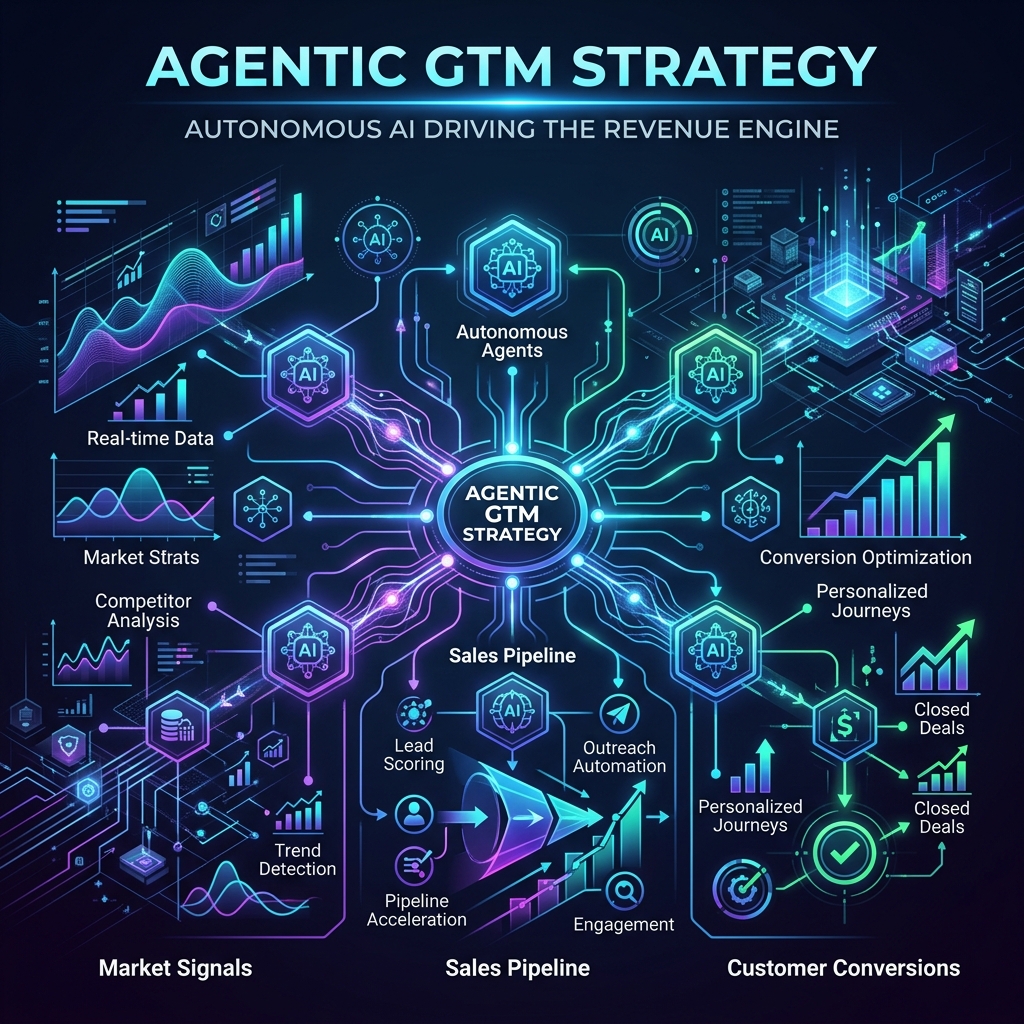
An Agentic GTM engine operates as a continuous loop, starting with market signals, moving through strategy and content execution, and closing with pipeline conversion.
graph TD
    A[Signal Ingestion: Competitor Spy & Market Signals] --> B[Strategic Routing: Target Audience Mapping]
    B --> C[Autonomous Generation: Campaign Builder Coordination]
    C --> D[Resonance Engine Check: Simulating Buyer Response]
    D --> E[Multi-Channel Deployment: Social, Email, SEO]
    E --> F[Lead Engagement: Conversational Nurturing]
    F --> A
1. Continuous Signal Ingestion
The engine continuously monitors the market. Using the Market Signal Analyzer, it identifies trending industry pains, shifts in competitor pricing, and active buyer intent signals across forums, social media, and web search.
2. Autonomous Strategy Orchestration
Instead of waiting for a marketing meeting, the strategy agent translates signals into concrete campaigns. It defines the ideal customer profile (ICP) and structures the conversion angle.
3. Coordinated Asset Generation
The Campaign Builder orchestrates specialized content nodes. A copywriting agent drafts the landing pages, a visual agent coordinates high-CTR ad designs in the AI Ad Creative Studio, and a sequence agent builds the outbound cold emails.
4. Predictive Resonance Testing
Before any content goes live, the Resonance Engine runs buyer persona simulations. It evaluates the copy against cognitive profiles to ensure maximum conversion before spending a single dollar on distribution.
Core Pillars of a Successful Agentic GTM Strategy
To construct an autonomous go-to-market pipeline that yields high-quality conversions, focus your implementation on these three strategic areas.
1. Establish a Unified Brand Kernel
For multi-agent systems to remain aligned, they must access a single source of truth for your brand voice, guidelines, and value propositions.
- The Tactic: Use Vect AI's Brand Voice Architecture to build your central Brand Kernel. Once configured, every agent—from your outbound email writer to your viral script generator—inherits these brand parameters automatically, eliminating off-brand output.
2. Connect Market Signals to Output
Autonomous agents should never create content in a vacuum. The most successful GTM strategies tie creation directly to real-time external signals.
- The Tactic: Set up active competitor monitoring using the Competitor Strategy Spy. When a competitor launches a new feature or receives negative reviews, configure your agents to automatically draft counter-positioning campaigns targeting those exact pain points.
3. Leverage Multi-Agent Collaboration
Avoid using a single generic LLM for all tasks. A premium GTM strategy uses discrete agents with specialized training that cross-review each other's deliverables.
- The Tactic: Run your campaigns through the Campaign Builder. It routes tasks between different specialized agents (e.g., SEO Specialist, Conversion copywriter, Lead Gen SDR) to ensure the final output is highly polished, cohesive, and structured for conversion.
Agentic GTM Deployment Checklist
Follow this checklist to activate your autonomous revenue engine:
[ ]Establish Brand Kernel: Complete your brand guidelines, target personas, and positioning angles.[ ]Define Outbound Channels: Map the primary channels you want to target (e.g., LinkedIn, Email, SEO blogs).[ ]Configure Competitor Targets: Add competitor domains to the strategy spy to feed real-time signals into the pipeline.[ ]Test Buyer Personas: Set up simulation profiles to run validation tests with the Resonance Engine.[ ]Integrate Conversion Tracking: Embed standard conversion metrics to allow the agents to track and self-optimize future campaigns.
Conclusion
The transition to Agentic GTM is redefining how high-growth businesses approach B2B marketing and sales. By moving away from rigid, manual workflows and deploying intelligent, self-correcting agent networks, companies can execute campaigns with unprecedented speed, consistency, and precision.
Ready to launch your autonomous GTM strategy?
Log into Vect AI, open the Campaign Builder, and deploy your first GTM agent team today.
Stop Reading. Start Scaling.
You have the blueprint. Now you need the engine. Launch the AI agent for "Campaign Builder" and get results in minutes.
Launch Campaign Builder