
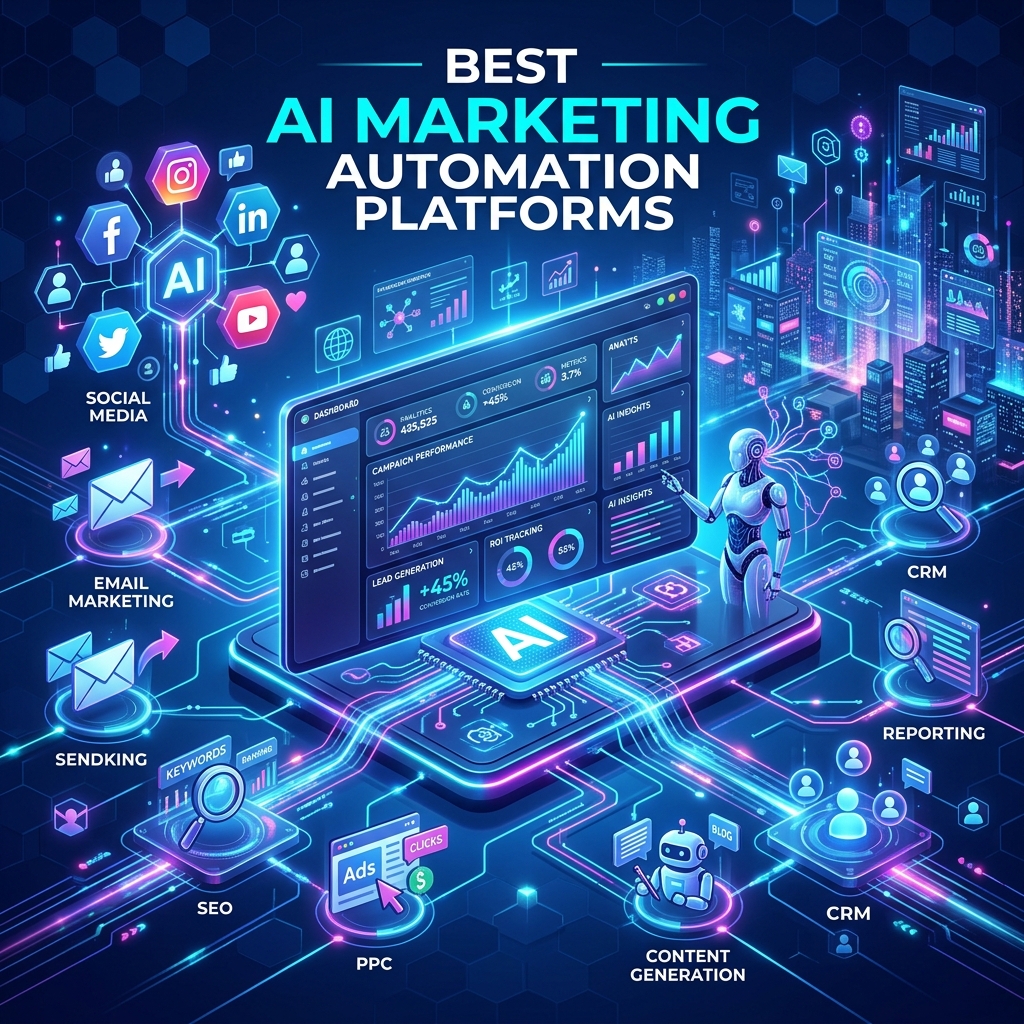
The digital ecosystem is evolving faster than ever, and legacy software stacks can no longer keep up with the demands of modern business growth.
In 2026, the brands that dominate their industries are not those with the largest marketing teams, but those with the smartest autonomous systems. The shift from manual, rules-based triggers to fully autonomous AI marketing automation platforms is the single greatest competitive advantage available today. These platforms act as an entire self-driving marketing department—constantly researching trends, building campaigns, writing copy, and analyzing data to maximize revenue.
By leveraging advanced, multi-agent ecosystems like Vect AI, companies are unlocking unprecedented operational efficiency. They are scaling their organic reach on search engines, dominating social media timelines, and accelerating B2B lead generation. In this definitive guide, we will explore why you must transition to AI-native marketing platforms, how they drive both business and social media growth, and the exact steps to implement them for your brand.
The Evolution of Marketing: From Rules to Autonomy
To appreciate the sheer power of modern AI marketing automation platforms, we first need to understand where we came from and why traditional tools are failing today's fast-paced businesses.
The Limits of Traditional Automation
For the past decade, "automation" meant setting up linear, "if-this-then-that" rules. You would manually write an email sequence, build a landing page, and set up a trigger: If a user downloads this eBook, send them Email A.
While this was a step up from manual mailing lists, it suffered from severe limitations:
- Manual Bottlenecks: A human still had to design the strategy, write the copy, create the graphics, and configure the complex logic trees.
- Static Responses: The system couldn't adapt. If market trends shifted overnight, your automated emails continued sending the same irrelevant message.
- Lack of Intelligence: Traditional tools did not "know" your brand voice or understand context. They simply moved data from Point A to Point B.
The Rise of Autonomous AI Platforms
The best AI marketing automation platforms of 2026 operate on a fundamentally different paradigm. Instead of waiting for you to tell them exactly what to do at every step, they are goal-oriented.
You provide an objective—such as "Increase B2B inbound leads from LinkedIn by 30% this quarter"—and the AI network takes over. Specialized AI agents collaborate to:
- Analyze your competitors and identify content gaps.
- Draft highly personalized outreach emails.
- Create and schedule engaging social media content.
- Monitor real-time market signals to adjust the strategy on the fly.
This level of intelligence transforms software from a mere "tool" into an active, autonomous Digital Employee.
How AI Marketing Automation Platforms Drive Exponential Business Growth
The primary mandate of any marketing platform is to generate revenue. AI marketing automation systems achieve this by removing friction, scaling output, and identifying opportunities that humans would miss.
1. Scaling Output Without Scaling Headcount
The most significant barrier to business growth is resource constraint. You want to launch a new product campaign, but your writers are busy, your designers are backlogged, and your media buyer is out sick.
With an autonomous platform like Vect AI's Campaign Builder, those constraints disappear. By inputting a single campaign objective, Vect AI's Orchestrator Agent coordinates a team of specialized sub-agents. Within minutes, the system generates:
- SEO-optimized long-form blog posts.
- A 5-step outbound email nurture sequence.
- High-converting landing page copy.
- A month's worth of social media posts.
This allows a single marketer or founder to output the work of an entire agency, driving massive business growth with zero additional overhead.
2. High-Intent B2B Lead Generation
Growth requires leads, but generic outreach no longer works. Modern buyers ignore templated emails and cold calls.
AI marketing automation platforms solve this through advanced signal tracking. Using tools like the Market Signal Analyzer and AI Lead Generation workflows, the AI monitors the web for specific buying signals. Did a target company just raise funding? Did their VP of Marketing ask a specific question on a forum?
When the system detects these signals, it immediately triggers the AI Cold Email Generator to draft a hyper-personalized message referencing that exact event, drastically increasing your open and conversion rates.
3. Continuous Optimization and A/B Testing
Traditional A/B testing is slow. You launch two variants, wait a month for statistical significance, and then pick the winner.
AI automation platforms perform continuous, micro-optimizations in real-time. They analyze engagement data, bounce rates, and click-through metrics across thousands of data points simultaneously. If an ad creative is underperforming, the AI will autonomously generate a new visual variant using the AI Image Studio Guide, rewrite the headline, and deploy the new version without human intervention.
Dominating Social Media Growth with AI Automation
While business growth is the ultimate goal, social media is the engine that drives brand awareness and community engagement. The best AI marketing automation platforms treat social media not as an afterthought, but as a dynamic ecosystem that requires constant attention.
1. Maintaining an Infinite Content Loop
Algorithm success dictates that you must post frequently and consistently. But creating fresh, engaging content every day leads to rapid burnout.
By utilizing Agentic Content Operations, AI platforms can turn one piece of macro-content (like this 2000+ word blog post) into an infinite loop of micro-content. The AI automatically extracts key statistics, compelling quotes, and actionable advice, formatting them perfectly for different networks.
It uses the AI Twitter Thread Generator to create a viral thread, the AI LinkedIn Post Generator to draft a professional insight post, and the AI Instagram Caption Generator for visual updates—all scheduled autonomously.
2. Real-Time Trend Hacking and Trendjacking
Social media moves at the speed of culture. If a news story breaks in your industry, being the first to comment establishes you as a thought leader.
You cannot plan for these moments in a monthly content calendar. However, an autonomous AI platform constantly monitors social sentiment and news feeds. When it identifies a rising trend relevant to your niche, it triggers a Trend Hacking Guide protocol. The AI drafts a highly relevant, insightful post and pings you for approval, allowing you to hijack the organic reach of trending hashtags seamlessly.
3. Flawless Brand Voice Consistency
A common fear with AI-generated content is that it will sound robotic or off-brand. The best platforms solve this with rigid architectural guardrails.
In Vect AI, this is handled by the Brand Kernel. This central repository stores your company's tone, vocabulary, restricted phrases, and buyer personas. Every single social media post generated by the platform is routed through a Compliance Agent that cross-checks the copy against your Brand Kernel. If a post uses too much jargon or deviates from your casual tone, the AI rewrites it before it ever reaches your dashboard.
Why Vect AI is the Premier Marketing Automation Platform for 2026
While many tools claim to use AI, most are simply traditional software wrappers with a ChatGPT text box bolted on. They still require you to do the heavy lifting of prompting, editing, and moving data between disparate systems.
Vect AI was built from the ground up as an Agentic AI Network. Here is why it stands out as the best platform for scaling your business and social growth:
The Multi-Agent Architecture
Vect AI doesn't rely on a single, generalized intelligence. Instead, it utilizes an Autonomous Marketing Orchestration system.
- The Orchestrator: Acts as your CMO, breaking down your high-level goals into actionable tasks.
- The Strategist: Researches keywords, analyzes competitors, and builds the roadmap.
- The Creatives: Specialized agents for copywriting, graphic design, and video scripting.
- The Deployer: Connects to your CMS, social accounts, and email servers to publish the assets.
- The Analyst: Monitors performance, attributes revenue, and feeds data back into the system to improve future campaigns.
The Conversion Killer Detector
Generating traffic is only half the battle; converting that traffic is where revenue is made. Vect AI includes a proprietary Conversion Killer Detector that autonomously audits your landing pages. It identifies psychological friction points, confusing copy, or poor UI elements, and provides actionable recommendations to fix your conversion rate instantly.
The Resonance Engine
Before you spend a dollar on paid ads, you need to know if your messaging will work. Vect AI's Resonance Engine simulates your target audience. It creates digital personas of your ideal buyers and tests your marketing copy against them, scoring the emotional resonance and likelihood of conversion before you launch the campaign.
Step-by-Step Guide to Implementing AI Marketing Automation
Ready to transform your marketing department? Follow this blueprint to implement an autonomous AI marketing automation platform successfully.
Step 1: Centralize Your Knowledge in the Brand Kernel
Before the AI can work for you, it must become you. Upload your brand guidelines, past successful emails, top-performing social posts, and customer interview transcripts into the platform. This creates the foundational DNA that ensures all future outputs are 100% aligned with your identity.
Step 2: Define Your Core Growth Objectives
Don't just ask the AI to "write a blog." Give it a business objective. For example: "Our goal is to increase SaaS demo bookings by 25% this month by targeting marketing directors who are frustrated with Hubspot's pricing."
Step 3: Map Out the Multi-Channel Funnel
Use the platform's Campaign Builder to outline the necessary assets. The AI will suggest a mix of SEO-optimized articles (like a Vect vs Hubspot comparison page), automated LinkedIn outreach, and targeted video ads.
Step 4: Review, Approve, and Deploy
While the platform operates autonomously, you remain the editor-in-chief. Review the generated assets, provide high-level feedback if necessary (e.g., "Make the tone slightly more aggressive"), and hit approve. The Deployment Agent takes over, scheduling the content across all channels.
Step 5: Monitor the Autonomous Optimization Loop
Once the campaign is live, your job isn't to analyze spreadsheets. The platform's Analytics Agent will monitor the data. If a specific email subject line is outperforming the others, the AI will autonomously double down on that messaging and adapt the rest of the campaign to match.
The Future of Marketing is Agentic
The transition to AI marketing automation platforms is not a passing trend; it is a fundamental shift in how businesses operate. We are moving from an era of Software as a Service (SaaS) to Service as a Software.
You are no longer buying a tool to help you do your job; you are hiring a digital workforce that executes the job for you. By embracing this technology, you free yourself from the grind of daily content creation and manual data entry. You elevate your role from a tactical operator to a strategic visionary.
SEO Guidelines & Checklist for Blog Posts
To ensure this content—and all future content generated by your AI platform—ranks on the first page of Google and is indexed by AI search engines (like ChatGPT and Perplexity), you must adhere to strict SEO protocols.
[x]Keywords in Metadata: Ensure your primary keyword ("AI marketing automation platforms") is included in the title, permalink (slug), and description, matching exact character limits.[x]Optimize for GEO (Generative Engine Optimization): Include clear, structured FAQ data (JSON-LD schema ready), markdown tables, and definitive answers so AI agents can easily cite your content. See our GEO Guide.[x]Internal and External Backlinks: Include at least 5-10 internal links to product features (Campaign Builder, Brand Kernel) and related guides (Lead Generation, Content Ops) to build a strong semantic web.[x]Natural Language Headings: Use descriptive, question-based H2s and H3s that align with high-volume search queries and user intent.[x]Clear Call to Action: Conclude the post with a direct, compelling link to enter the product funnel.
Accelerate Your Business Growth Today
The gap between businesses using traditional marketing tools and those leveraging autonomous AI platforms is widening every day. Do not get left behind manually writing emails and scheduling social posts while your competitors deploy entire digital marketing departments at the click of a button.
It is time to automate your strategy, scale your output, and dominate your niche.
Start building your autonomous growth engine today.
Stop Reading. Start Scaling.
You have the blueprint. Now you need the engine. Launch the AI agent for "Campaign Builder" and get results in minutes.
Launch Campaign Builder