
Web search has evolved past simple answers. In 2026, AI is no longer just reading the web—it is acting on it.
With the commercial rollout of OpenAI's Operator, Anthropic's Computer Use API, and Google's Jarvis, the digital landscape has entered the era of Machine-to-Machine (M2M) interaction. Instead of a human opening Safari, searching for a product, comparing options, and manually checking out, they delegate the entire workflow to an autonomous AI agent: "Find the best email marketing tool under $100/mo, check if it integrates with my CRM, and sign up for a trial account."
When an agent enters your website, it doesn't navigate like a human. It scans DOM elements, looks for interactive buttons, maps pricing tiers, and seeks to execute the user's intent in seconds. If your website has broken buttons, poor layout labels, or hidden interactive elements, the agent will fail its mission and move to a competitor.
To capture this transaction volume, you must implement an AI Agent SEO (or Optimization for AI Agents - OAA) strategy.
In this playbook, we'll explain how web-browsing agents operate and how you can use Vect AI to make your website agent-ready.
Human Search vs. Chatbot Search vs. AI Agent Navigation
Optimizing for web-browsing agents requires building interfaces that are easily understood by computer-vision models and DOM parsers.
| Paradigm | Human Browsing (Traditional) | GEO / AEO (Text AI) | AI Agent SEO (OAA) |
|---|---|---|---|
| User Type | Human eyes and fingers | LLM crawlers reading text | Autonomous browser agents executing tasks |
| Interaction Goal | Consuming content & clicking | Compiling data & citations | Performing actions (forms, checkouts, logs) |
| Key Optimization | Visual UX, copy, headings | Structured text, tables, JSON-LD | ARIA labels, simple DOM paths, clear selectors |
| Friction Point | Boring copy, bad layout | Missing schema, vague facts | Capchas, bad selectors, broken JavaScript |
| Core Metric | Clicks, time on page | Citation share of voice | Task completion success rate |
How Web-Browsing AI Agents Interact with Your Site
To build an agent-optimized website, you must understand how these systems browse the web. Most browsing agents use a combination of visual screenshots (computer vision) and DOM hierarchy parsing.
graph TD
    A[Agent Receives Goal: e.g. Buy Subscription] --> B[Agent Browses to Target URL]
    B --> C[Page Capture: Visual Screenshot & DOM Parsing]
    C --> D[Action Mapping: Locating Buttons, Links, & Input Fields]
    D --> E[Execution: Clicking, Typing, & Submitting Forms]
    E --> F[Verification: Checking Success State & Returning Confirmation]
1. Page Ingestion
The agent loads your URL in a headless browser. It takes screenshots of the viewport and extracts the DOM tree. Models like Anthropic's Computer Use analyze the visual coordinates of elements to decide where to click.
2. Action Mapping
The agent looks for standard interactive patterns. It identifies text fields (e.g., email inputs), buttons (e.g., "Sign Up Now"), and navigation elements. If your buttons are coded as unlabelled <div> tags, the agent's coordinate planner may miss them.
3. Step-by-Step Execution
The agent clicks, types, and navigates. It handles form steps and modal overlays. If it encounters a complex interstitial page or unexpected popup, the agent might get stuck and abort.
4. Success State Validation
After submitting a form or purchase, the agent scans the final screen for a confirmation message or a change in URL state to verify the task is complete before reporting back to the user.
Key Strategies for AI Agent SEO (OAA)
Follow these core implementation strategies to optimize your brand's interface for autonomous agents.
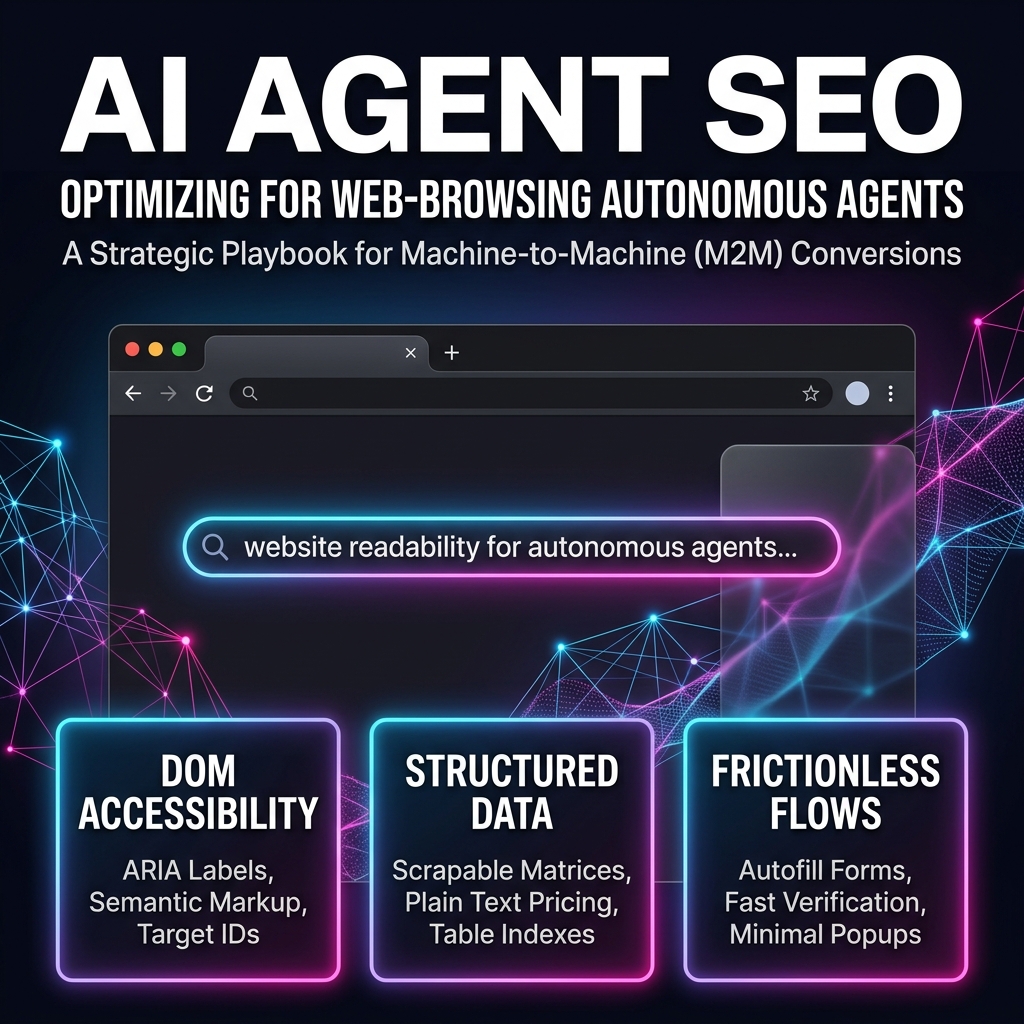
1. Maintain Pristine accessibility (ARIA Labels) and Clean DOMs
Browsing agents rely heavily on HTML accessibility structures to identify target elements. If a button lacks descriptive labels, the agent has to guess its function.
- The Tactic: Ensure every button, input, and interactive link has explicit
aria-labeloridattributes. Instead of<div onclick="...">Sign Up</div>, use<button aria-label="Sign up for Vect AI free trial">Sign Up</button>. Use Vect AI's Conversion Killer Detector to find interface tags that confuse agent scripts.
2. Standardize Pricing and Feature Presentation
Agents compare features and pricing across vendors. They prefer structured layouts over ambiguous sales pitches.
- The Tactic: Present your product features, limits, and pricing in clear markdown tables or structured list formats. Always include a dedicated pricing page (e.g.,
/pricing) with clear text specifying limits (e.g., "10,000 emails/month").
3. Establish Agent-Friendly Landing Pages
Create simplified entry routes designed specifically for API-like agent interactions.
- The Tactic: Make your registration and checkout funnels as frictionless as possible. Ensure forms support standard autofill properties (e.g.,
autocomplete="email"). Eliminate multi-page onboarding screens for agent traffic by offering quick, single-click social logins or email-based registration.
4. Host an llms.txt and Entity Schema File
Provide a structured, text-only directory at the root of your domain (/llms.txt) that maps your site's capabilities, pages, and interactive features.
- The Tactic: Set up an
llms.txtfile (read our implementation blueprint: llms.txt SEO Guide) listing all major tools and signup paths. This helps agents navigate your layout index without scraping every single page.
AI Agent SEO Ingestion Checklist
Ensure your website is ready for autonomous agent browsing:
[ ]Verify Semantic Buttons: Confirm all interactive elements are semantic HTML<button>or<a>tags.[ ]Add Explicit ARIA Attributes: Inject descriptivearia-labeltext to all form inputs and action triggers.[ ]Deploy a Clear/pricingMatrix: Format your pricing details in plain tables that agents can scrape without visual issues.[ ]Check Autofill Support: Verify input fields have standardname,id, andautocompletefields.[ ]Validate on Agent Simulators: Run testing loops using headless scripts to check for elements that block automation.
Conclusion
The web is no longer built exclusively for humans. As autonomous web agents assume the burden of comparison, booking, and purchasing, the websites that survive will be those that are readable, accessible, and structured for machine navigation. By optimizing your HTML structure, clarifying your transactional funnels, and standardizing your product data, you position your brand as the easiest path for AI agents to choose.
Ready to prepare your GTM presence for the agentic web?
Log into Vect AI, open the SEO Content Strategist, and run an agent-readiness audit on your platform today.
Stop Reading. Start Scaling.
You have the blueprint. Now you need the engine. Launch the AI agent for "SEO Content Strategist" and get results in minutes.
Launch SEO Content Strategist