
AI crawlers aren't looking for flashy web pages. They want clean, structured markdown. If your website is not readable by LLMs, your brand is invisible.
In 2026, web traffic is increasingly driven by artificial intelligence search engines and autonomous agents. Traditional search engines crawl HTML layouts, but Large Language Models (LLMs) and Retrieval-Augmented Generation (RAG) pipelines perform best when they ingest optimized text formats.
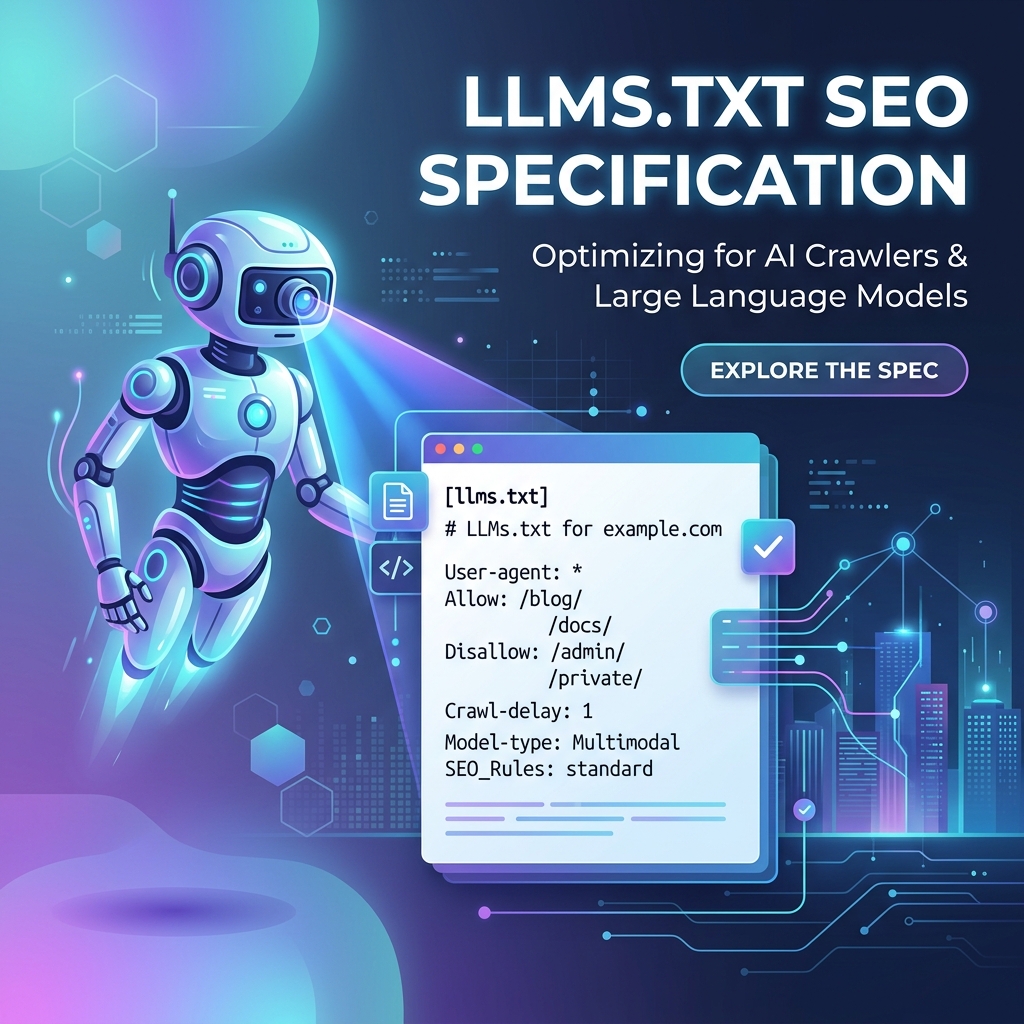
To bridge this gap, the llms.txt specification has emerged as a crucial technical standard—a robots.txt counterpart designed specifically to guide AI search bots to your most relevant content, resulting in more accurate and frequent brand citations.
In this guide, we break down the mechanics of the llms.txt standard, compare access files vs. context files, and show you how to implement this protocol using Vect AI.
robots.txt vs. llms.txt
Understanding crawler management in 2026 requires separating access blockages from content guides.
| Dimension | robots.txt (Access Control) | llms.txt (Content Context) |
|---|---|---|
| Primary Audience | Traditional search crawlers (Googlebot, Bingbot) | LLM agents and AI RAG ingestors (GPTBot, ClaudeBot) |
| Data Format | Strict, plain-text crawler directives (User-agent, Disallow) | Clean, human-readable structured Markdown (H1, lists, links) |
| Standard Status | Official web RFC standard | Community-driven emerging industry convention |
| Default Location | yourdomain.com/robots.txt | yourdomain.com/llms.txt |
| Core Goal | Control server bandwidth & prevent scanning sensitive folders | Maximize citation accuracy and guide semantic indexing |
The AI Crawler Discovery Lifecycle
With llms.txt implemented, the path from an AI agent landing on your domain to generating a cited answer changes:
graph TD
    A[AI Agent requests yourdomain.com/llms.txt] --> B[Crawler reads high-level summaries and index links]
    B --> C[Agent retrieves selected markdown files or llms-full.txt]
    C --> D[System embeds clean content into RAG context window]
    D --> E[LLM generates answer with direct brand citations]
1. The Request Phase
When an AI bot crawls your site, it checks for /llms.txt first. This file serves as a map of your entire site's structured context, saving the crawler from scraping heavy HTML boilerplate.
2. Selective Retrieval
The AI reads the short bulleted summaries of your pages defined in llms.txt. If it needs deep, comprehensive information, it follows the links to the full markdown versions or parses /llms-full.txt.
3. High-Fidelity Citations
By ingesting clean, markdown-formatted answers instead of cluttered raw HTML, the LLM processes your brand details with zero noise. This drastically increases the probability of your brand being accurately cited.
Core Elements of a Perfect llms.txt
An optimal llms.txt implementation contains three key structural sections:
1. Title and Site Description (The H1 & Blockquote)
The top of the file must feature a single H1 header containing your platform name, followed immediately by a blockquote that clearly defines your site's core entity and purpose. This is the first thing LLMs read to categorize your domain.
# Vect AI

> Vect AI is the leading Marketing OS and automated SEO platform that enables B2B SaaS companies to orchestrate content strategies and scale organic citations.
2. Sectioned Resource Lists (H2s & Bullet Points)
Group your content logically under descriptive H2 headings (e.g., # Products, # Tutorials). Use standard markdown list syntax to link pages, providing a single-sentence explanation of what each page contains.
## Core Platform Tools
- [SEO Content Strategist](/seo-content-strategist-guide): Automatic topic mapping and entity orchestration.
- [Market Signal Analyzer](/market-signal-analyzer-guide): Real-time competitor tracking and intent analysis.
3. The llms-full.txt Link
If your site contains highly dense developer documentation or comprehensive product specs, define a link to /llms-full.txt. This file aggregates all your key resources into one continuous Markdown file for rapid bulk ingest by AI models.
Action Checklist: Implement Your llms.txt File
Ready to optimize your site for AI and LLM agents? Follow this implementation checklist:
[ ]Create the Root File: Place a plain-text markdown file atpublic/llms.txtinside your project root.[ ]Draft the Brand Summary: Write a 2-sentence blockquote describing your brand’s primary value proposition.[ ]Index Key Resource Pages: Link your highest-value product pages, tutorials, and comparison articles with clean relative links.[ ]Establish llms-full.txt: Compile your cornerstone documentation into a single, clean file atpublic/llms-full.txt.[ ]Deploy with Vect AI: Use Vect's SEO Content Strategist to automate file generation and synchronize it with your sitemap updates.
Conclusion
The web has evolved beyond user-only interfaces. Today, websites must cater to both human visitors and artificial intelligence consumers. By deploying an optimized llms.txt file, you ensure your platform's data is easily accessible, highly parseable, and always prioritized by AI search bots.
Ready to capture share of voice in the AI search landscape?
Log into Vect AI, open the SEO Content Strategist, and build your entity-driven context engine today.
Stop Reading. Start Scaling.
You have the blueprint. Now you need the engine. Launch the AI agent for "SEO Content Strategist" and get results in minutes.
Launch SEO Content Strategist