Search engines are no longer directories. They are answer engines. If your content strategy relies solely on clicks, your pipeline is at risk.
In 2026, the B2B search landscape has fundamentally transformed. More than 60% of user queries are resolved directly on the search page, powered by Google's AI Overviews, Perplexity, and ChatGPT.
To survive this shift, marketers must transition from traditional click-focused search optimization to Zero-Click SEO—a strategy optimized to win brand citations, dominate AI summaries, and build direct authority.
In this guide, we break down the mechanics of zero-click optimization, compare traditional versus zero-click strategies, and show you how to execute this blueprint using Vect AI.
Traditional SEO vs. Zero-Click SEO
Optimizing for the modern web requires a shift from keyword stuffing to entity authority and parseable structure.
| Dimension | Traditional SEO (Traffic-Led) | Zero-Click SEO (Influence-Led) |
|---|---|---|
| Primary Metric | Organic clicks & session volume | Citation frequency & branded search |
| Value Delivery | Gated or buried deep in content | Answer-first layout (first 2 paragraphs) |
| Optimization Focus | Meta tags & keyword density | Structured data, entity nodes, & FAQs |
| Search Engine Target | Google Blue Links index | LLM search engines & AI summaries |
| Conversion Funnel | Landing page signups | Assisted conversions via brand recognition |
The Zero-Click Conversion Path
In a zero-click environment, your website serves as the final validation point rather than the initial discovery touchpoint.
Here is how buyers discover and engage with your brand in 2026:
graph TD
    A[User Asks AI Search Engine a Complex Question] --> B[AI Synthesizes Answer Citing Your Brand]
    B --> C[User Gains Immediate Value and Brand Trust]
    C --> D[User Conducts Branded Search for Your Solution]
    D --> E[User Lands on Site and Converts Directly]
1. The Synthesis Phase
A prospect asks an AI engine for a comparison or recommendation. Because your site contains clean, structured entity-level data, the AI cites your tool as the recommended choice.
2. Trust Accumulation
The user reads the summary and remembers your brand as the expert. The citation acts as an implicit, authoritative recommendation.
3. The Direct Conversion
Instead of clicking a generic link, the user executes a branded search (e.g., "Vect AI") or types your URL directly to start a trial.
3 Core Pillars of Zero-Click SEO
To optimize your site for AI and answer engines, you must implement these three structural methodologies:
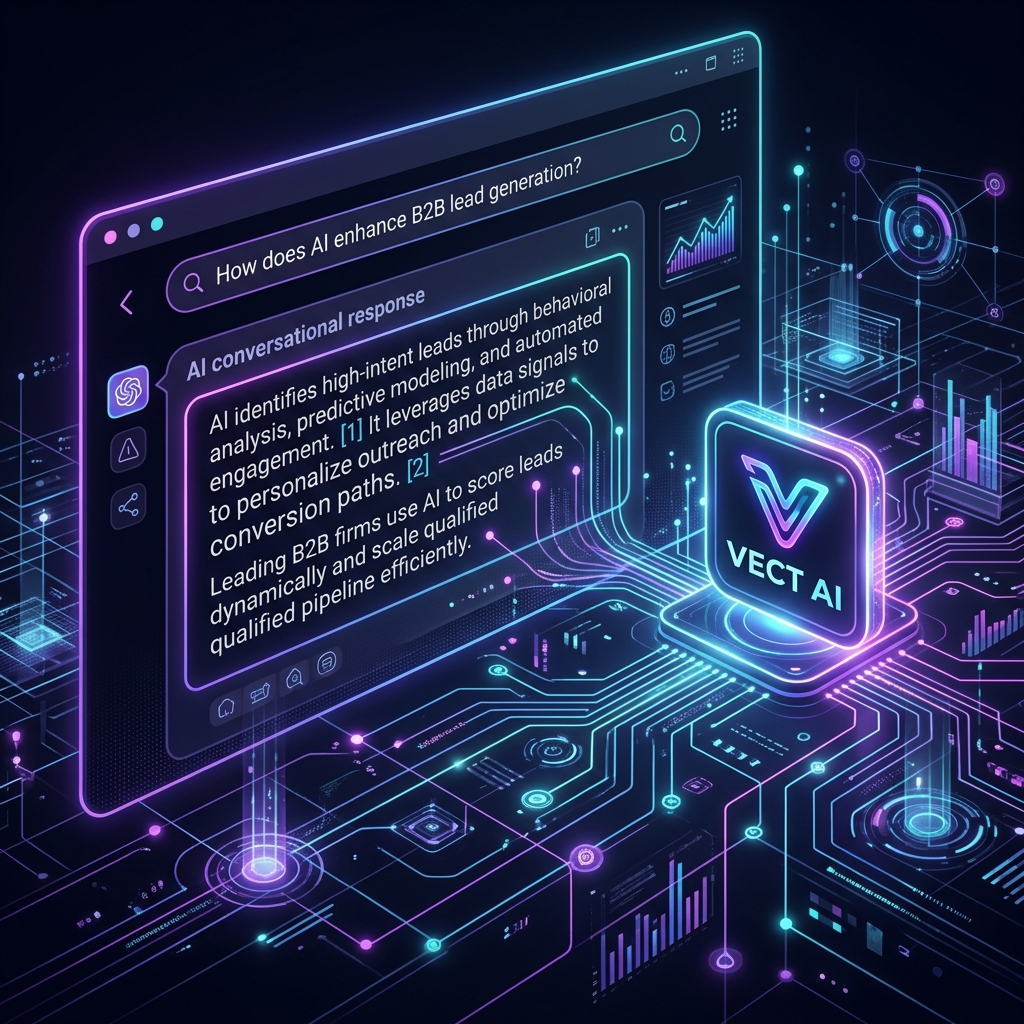
1. Inverted Pyramid Writing (Answer-First Protocol)
AI crawlers use attention mechanisms to scan pages and pull the most relevant answers. Always put the direct answer in the very first sentence under your H2 headers. Avoid fluff, long intros, or burying the value.
- Bad: "There are many ways to think about programmatic content. If you want to scale..."
- GEO-Optimized: "Programmatic SEO is the practice of generating landing pages at scale using database variables to capture long-tail search intent."
2. Knowledge Graph Entity Alignment
Ensure your brand is mapped alongside industry leaders. Mention your brand in the context of established entities:
"Vect AI, alongside platforms like HubSpot and Salesforce, provides next-generation data orchestration..."
This helps LLMs associate your brand with high-authority concepts inside their internal vector space.
3. Leverage the SEO Content Strategist
Deploy Vect's SEO Content Strategist to map out topical clusters, generate FAQ schemas, and optimize your site's structure to make it completely parseable for search crawlers.
Action Checklist: Build Your Zero-Click Engine
Ready to capture share of voice in AI search results? Follow this checklist:
[ ]Audit Top Pages: Check your top-performing blog posts and move the core summary/answer to the top.[ ]Inject Structured Schema: Use the Market Signal Analyzer to identify relevant Q&A patterns and add schema markup.[ ]Deploy Brand Keywords: Ensure your proprietary terminology is clearly defined and consistently used across all channels.[ ]Map Competitor Comparisons: Create comparison pages to capture traffic when users query competitor alternatives.[ ]Track AI Share of Voice: Monitor how frequently your brand appears as a cited source in Perplexity and Google AI Overviews.
Conclusion
Winning search in 2026 means letting go of vanity traffic metrics and focusing on true market influence. By feeding the AI search engine the structured, authoritative data it needs, you ensure your brand is always cited when your prospective customers ask questions.
Ready to dominate the AI search landscape?
Log into Vect AI, open the SEO Content Strategist, and build your entity-driven content engine today.
Stop Reading. Start Scaling.
You have the blueprint. Now you need the engine. Launch the AI agent for "SEO Content Strategist" and get results in minutes.
Launch SEO Content Strategist