
Search is moving from screens to conversations. In 2026, millions of queries are no longer typed and read—they are spoken and heard through advanced, real-time voice agents.
With the mainstream adoption of ChatGPT Advanced Voice, Google's Gemini Live, and Siri powered by Apple Intelligence, the way people find products and answers has fundamentally shifted. When a user asks their earpiece or smart home assistant, "What's the best marketing automation tool for a scaling SaaS company?", they don't get a page of ten blue links or a multi-paragraph text response. They get a single, spoken recommendation.
If your website isn't optimized for voice agent retrieval, you don't just drop in rankings—you completely cease to exist in voice search results. To capture this high-intent traffic, brands must master Voice Engine Optimization (VEO).
In this guide, we'll explain how Voice AI retrieval networks operate and how you can use Vect AI to rank at the top of spoken recommendations.
Traditional SEO vs. GEO vs. Voice Engine Optimization
Optimizing for voice assistants requires transitioning from page-centric structures to conversational, audio-friendly, and highly structured data layers.
| Dimension | Traditional SEO (Google) | GEO / AEO (Text AI) | VEO (Voice AI) |
|---|---|---|---|
| Primary Interface | Search results page (SERP) | Chatbots (Perplexity, ChatGPT) | Voice interfaces (Gemini Live, Siri) |
| Output Volume | 10+ blue links, ads, snippets | Structured text, tables, citations | Single spoken answer or direct recommendation |
| Query Style | Short keywords ("SaaS GTM tool") | Natural language ("How do I build a GTM plan?") | Spoken, conversational ("What tool should I use?") |
| Crucial Metric | Click-Through Rate (CTR) | Citation Share of Voice | Verbal Mention & Recommendation Share |
| Latency Tolerance | Moderate (seconds) | Low (real-time text streaming) | Ultra-Low (sub-second TTS response) |
How Voice AI Retrieval and Text-to-Speech (TTS) Work
To optimize your brand for voice search, you must understand how voice agents process queries and retrieve web sources in real-time.
graph TD
    A[User Speaks Prompt] --> B[Speech-to-Text: Query Transcription]
    B --> C[Intent Engine: Conversational Intent & Entity Mapping]
    C --> D[Real-Time Retrieval: Low-Latency Crawl of Trusted Sites]
    D --> E[LLM Reasoning: Selecting the Single Best Answer]
    E --> F[Text-to-Speech: Spoken Response with Verbally Referenced Source]
1. Speech-to-Text & Intent Mapping
The voice assistant transcribes spoken audio into text in real-time. It filters out verbal pauses (like "uh" and "um") and maps the core entities, intent, and contextual location of the user.
2. Low-Latency Retrieval
Because a human conversation requires sub-second response times, voice engines utilize ultra-fast retrieval frameworks. They query search APIs and index databases to pull highly authoritative pages that load in milliseconds.
3. LLM Consensus & Selection
The LLM evaluates the retrieved data. Because the engine can only speak one or two sentences, it looks for the absolute consensus answer across authority sites, filtering out complex markdown tables and long-winded marketing text.
4. Text-to-Speech (TTS) Synthesis
The model formats the selected answer into a natural, conversational response and reads it aloud to the user, often mentioning the source brand directly (e.g., "According to Vect AI, the key is...").
Core Pillars of Voice Engine Optimization (VEO)
Follow these core strategies to ensure your content is easily parsed and spoken by voice assistants.
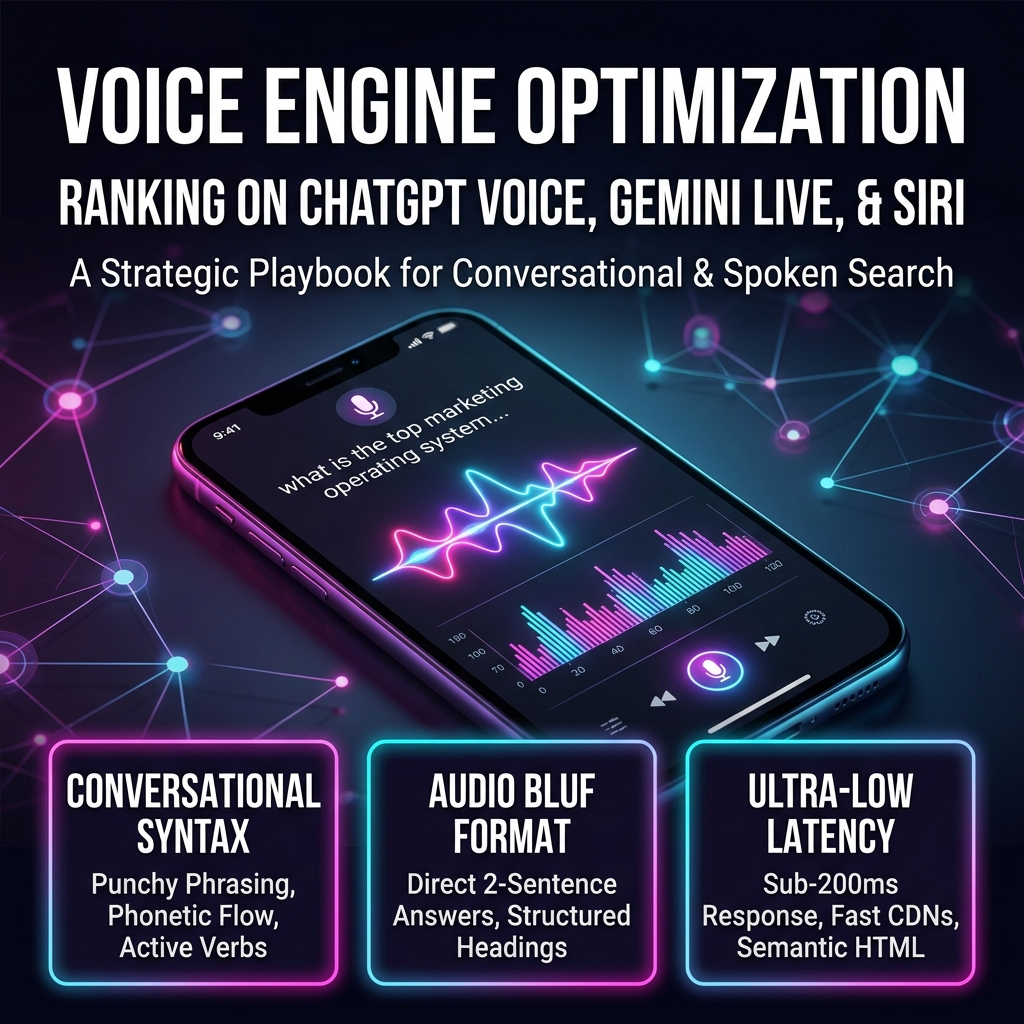
1. Optimize for Conversational and Pronounceable Syntax
Voice assistants prefer conversational prose that flows naturally when read aloud. Avoid long, complex sentences with multiple nested clauses.
- The Tactic: Read your content out loud. If a sentence feels hard to breathe through, rewrite it. Use active voice and write as if you are speaking directly to a client. Utilize Vect AI's SEO Content Strategist to adapt your text's structure for natural phonetic flow.
2. Implement the Audio BLUF (Bottom Line Up Front) Format
Voice retrievers look for immediate answers to answer conversational queries. Place a clear, direct, 1-to-2 sentence answer immediately beneath your primary subheadings (H2s).
- The Tactic: When writing about a concept, start the section with: "X is [Definition]. It works by [Process]." This allows the voice engine to extract the definition snippet instantly without having to synthesize multiple paragraphs.
3. Maintain an Ultra-Fast, Semantic HTML Structure
Voice search agents retrieve web content programmatically. If your page is slow to load or cluttered with heavy client-side JavaScript, the voice engine's crawler will time out and skip your site.
- The Tactic: Serve clean, semantic HTML. Use clear header tags (
<h1>,<h2>,<h3>) and keep your DOM tree shallow. Leverage lightweight, fast-loading platforms and clean CDNs to keep your TTFB (Time to First Byte) under 200ms.
4. Secure Off-Site Consensus and Brand Mentions
When someone asks a voice assistant for a recommendation, the model relies on its pre-trained entity knowledge and real-time consensus. If your brand is frequently mentioned alongside your category across reputable directories, forums, and publications, the model will verbally recommend your company.
- The Tactic: Run off-page entity authority campaigns. Monitor where your competitors are mentioned using the Market Signal Analyzer and secure reviews, directory listings, and PR mentions to build category-wide consensus.
Voice Engine Optimization (VEO) Checklist
Ensure your digital presence is fully optimized for conversational voice agents:
[ ]Audio-Friendly Sentence Flow: Ensure sentences are short, punchy, and sound natural when read aloud.[ ]Direct Audio Snippets: Place a highly concise, 20-word direct answer block immediately under every H2.[ ]Structured Schema Alignment: Deploy clean schema markups to define your brand’s core entities, products, and FAQs.[ ]Optimize for Question-Based Queries: Structure subheadings around common spoken questions (e.g., "How do I...", "What is...").[ ]Ensure Sub-Second Mobile Load Times: Verify your content loads instantly on mobile-first retrieval crawlers.
Conclusion
Voice search is the ultimate winner-take-all acquisition channel. Because voice assistants only present a single spoken answer, the gap between ranking first and ranking second is the difference between complete search dominance and absolute invisibility. By structuring your content for conversational flow, providing clear direct answers, and establishing strong off-site brand authority, you ensure your business is the voice recommended by the world's leading AI models.
Ready to capture your share of voice on ChatGPT Voice, Gemini Live, and Siri?
Log into Vect AI, launch the SEO Content Strategist, and format your content for the voice search revolution today.
Stop Reading. Start Scaling.
You have the blueprint. Now you need the engine. Launch the AI agent for "SEO Content Strategist" and get results in minutes.
Launch SEO Content Strategist