Websites are no longer just for human eyes. You are now designing for the machine.
For decades, digital marketing relied on attracting human visitors. We built landing pages with emotional hooks, designed colorful call-to-action buttons, and optimized layouts to guide user mouse movements toward a checkout form.
In 2026, a massive shift has occurred.
Over 35% of transactional actions and product research tasks are now executed by autonomous AI agents (such as OpenAI's Operator, Anthropic's browser-use models, and Gemini-powered digital employees). These agents do not read websites like humans. They do not get swayed by flashy banners. Instead, they parse raw markup, interact with APIs, click buttons, and execute processes programmatically.
If your website contains complex JavaScript loaders, unlabelled form inputs, or blocks automated interactions, you are invisible to these agents. To survive, you must pivot to Search Engine Agent Optimization (SEAO).
In this guide, we will break down the exact strategies to make your website fully agent-accessible and show you how to leverage Vect AI to win in the agent-first economy.
What is Search Engine Agent Optimization (SEAO)?
Search Engine Agent Optimization (SEAO) is the technical and semantic optimization of web design, code, and APIs to ensure autonomous AI web agents can successfully navigate, evaluate, and transact on your website on behalf of human users.
While traditional SEO focuses on getting human clicks, and GEO/AEO focuses on getting text citations in AI search summaries, SEAO focuses on action execution compatibility.
Traditional SEO vs. GEO vs. SEAO
| Dimension | Traditional SEO | Generative Engine Optimization (GEO) | Search Engine Agent Optimization (SEAO) |
|---|---|---|---|
| Primary Target | Human users browsing search results | Conversational LLMs (ChatGPT, Perplexity) | Autonomous Web Agents (OpenAI Operator) |
| Core Goal | High organic CTR & page views | Citations and brand recommendations | Unhindered action execution & conversion |
| Format Value | Text density & Keyword usage | Factual structure & FAQ schemas | Semantic HTML, clear DOM, clean APIs |
| Conversion Event | Human clicking a CTA button | Brand citation in AI responses | Agent completing checkout/signup |
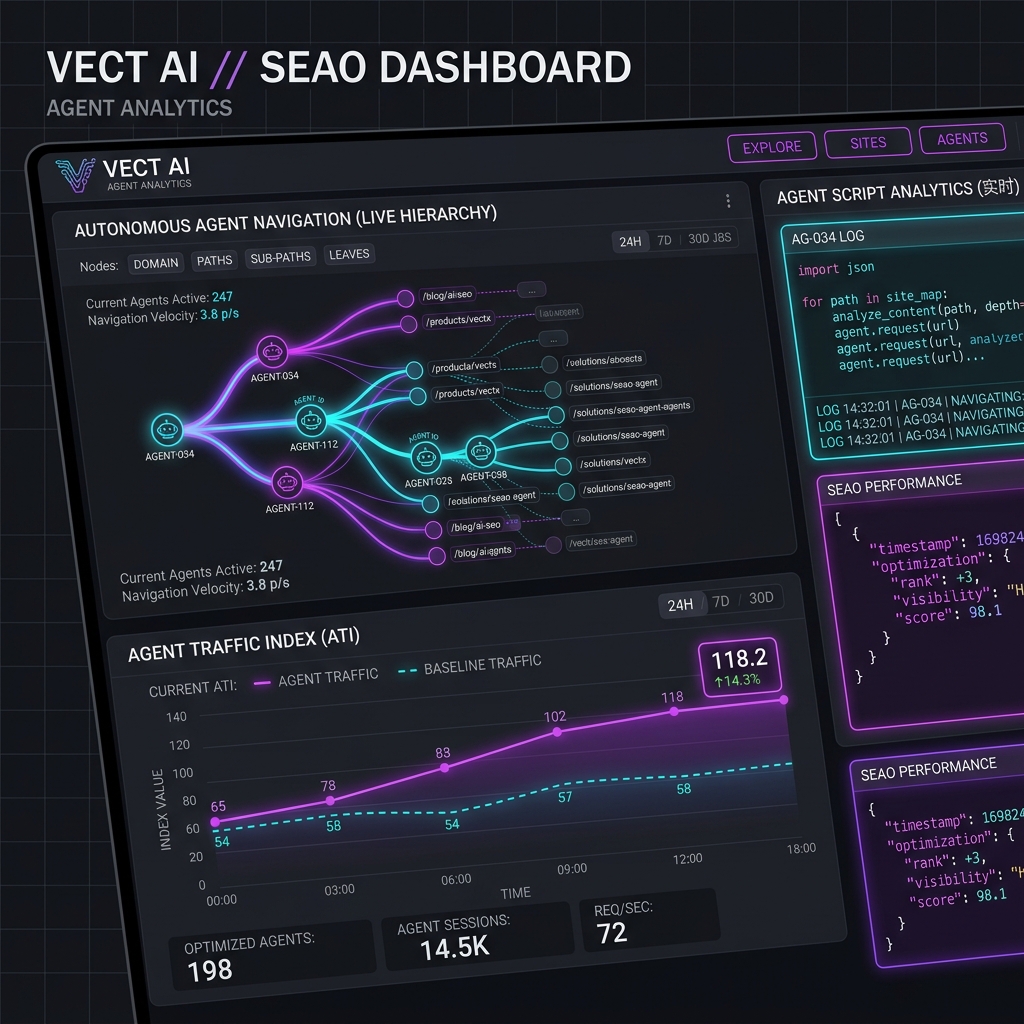
How AI Web Agents Navigate Your Site
Unlike traditional crawler bots, modern AI agents navigate websites by analyzing screenshots of the DOM and executing mouse or keyboard actions.
Here is the step-by-step loop of how an AI agent interacts with a web page:
graph TD
    A[Agent Receives Goal: e.g. Buy Vect AI Pro] --> B[Agent Launches Headless Browser Session]
    B --> C[Page Rendered: Screenshot & DOM Tree Compiled]
    C --> D[Visual-Textual Mapping: Identifies Click Targets]
    D --> E[Action Execution: Clicks, Scrolls, or Enters Text]
    E --> F[Verification: Evaluates New Page State]
    F --> G[Goal Achieved: Completes Transaction]
1. Goal Formulation
The human user enters a high-level command (e.g., "Find the pricing comparison for Vect AI and Jasper, and sign up for the best plan using my business profile").
2. Browser Navigation
The agent navigates to target pages, loading all resources, including JavaScript bundles and interactive layouts.
3. Screen and DOM Parsing
The agent takes a visual screenshot of the viewport and compiles the accessibility tree of the DOM. It maps coordinates of elements like buttons, inputs, and links.
4. Interactive Steps
The agent programmatically inputs text (such as email addresses) and fires click events. If forms lack descriptive labels or rely on non-standard mouse tracking, the agent's scripts fail, and it leaves the site.
The 4 Pillars of a Successful SEAO Strategy
1. Semantic Accessibility (The DOM Blueprint)
AI agents rely on a site's accessibility tree (ARIA labels, roles, and alt texts) to understand the function of buttons and inputs.
- The Tactic: Ensure every form field has an explicit, readable
<label>. Avoid empty buttons with only icon SVGs; always add anaria-label(e.g.,aria-label="Submit signup form"). Use Vect AI's SEO Content Strategist to scan and audit your page structure for accessibility-first agent compatibility.
2. Standardized Schema Integration
Provide a clear machine-readable blueprint of your pricing, products, and features. When agents arrive on your site, they read schema markups in milliseconds rather than scraping paragraphs.
- The Tactic: Deploy valid
ProductandOfferschema markups that clearly state pricing tiers, feature lists, and checkout endpoints.
3. Agent-Friendly robots.txt & API Endpoints
Do not treat helpful transactional agents like malicious scraping bots. Your technical setup should make it easy for verified agent crawlers to interact with your site.
- The Tactic: Create a
/llms.txtfile listing your primary pages and structured product documentation. Maintain a clean public API that agents can fallback to if headless browser rendering fails.
4. Eliminate CAPTCHA Roadblocks
Traditional CAPTCHAs stop bot spam, but they also prevent high-intent customer agents from completing transactions.
- The Tactic: Implement invisible, behavioral-based spam protection (like Cloudflare Turnstile) that allows verified commercial AI agents to pass while filtering out malicious bad actors.
The SEAO Implementation Checklist
Verify your website is fully optimized for autonomous AI web agents with this checklist:
[ ]Semantic Forms: Ensure all input fields feature descriptive labels and explicit ARIA properties.[ ]Icon Button Labels: Check that all graphical or icon-only buttons include cleararia-labeldefinitions.[ ]Robots Accessibility: Confirm that yourrobots.txtdoes not block verified user-agents likeGPTBotorPerplexityBot.[ ]Structured Pricing Schema: Deploy validProductandOfferJSON-LD schema markups detailing pricing models.[ ]Invisible Protection: Transition away from visual puzzle CAPTCHAs to invisible, behavior-based bot detection.
Conclusion
The future of web traffic is agentic. Optimizing solely for human readers leaves your business invisible to the autonomous digital employees that make purchasing and research decisions in 2026.
By implementing Search Engine Agent Optimization (SEAO) today, you ensure that AI web agents can effortlessly navigate your digital ecosystem, compare your offerings, and finalize transactions.
Ready to future-proof your website's SEO for AI agents?
Log into Vect AI, open the SEO Content Strategist, and deploy our agent-ready page templates and automated schema audits.
Stop Reading. Start Scaling.
You have the blueprint. Now you need the engine. Launch the AI agent for "SEO Content Strategist" and get results in minutes.
Launch SEO Content Strategist