
AI search has evolved beyond simple summarization. With the rise of reasoning-based language models, the race is now for logical alignment and validation.
In 2026, standard search engine optimization and even early Generative Engine Optimization (GEO) are no longer enough. The launch of reasoning models like OpenAI's o1/o3-mini and DeepSeek-R1 has changed how AI systems process web information. Instead of merely summarizing the top ten retrieved pages, these engines perform multi-step chain-of-thought analysis, evaluate the credibility of claims, check for contradictions, and synthesize verified consensus.
If your content contains unsupported claims or disorganized structures, reasoning engines will flag and exclude your brand. To stay visible in conversational search, you must implement Reasoning Engine Optimization (REO).
In this playbook, we explore how reasoning models evaluate information and outline the exact optimization strategies to secure citations using Vect AI.
Traditional SEO vs. GEO vs. REO
Optimizing for reasoning models requires moving past keyword placement and semantic density toward logical verification and structured data.
| Optimization Pillar | Traditional Google SEO | Generative Engine (GEO) | Reasoning Engine (REO) |
|---|---|---|---|
| Primary Target | Keyword index and PageRank | LLM summarizers (Perplexity, Gemini) | Reasoning graphs (o1, DeepSeek-R1) |
| Processing Style | Single-query pattern matching | RAG context compression | Multi-step chain-of-thought validation |
| Content Priority | Content length & backlink authority | Semantic density & direct answers | Logical consistency & quantitative facts |
| Format Preference | Headings, paragraphs, metadata | Bullet lists, Q&As, definitions | Markdown tables, step-by-step processes |
| Core Filter | Crawlability and spam scores | Context limit constraints | Contradiction checks & fluff detection |
The Reasoning Retrieval-Evaluation Loop
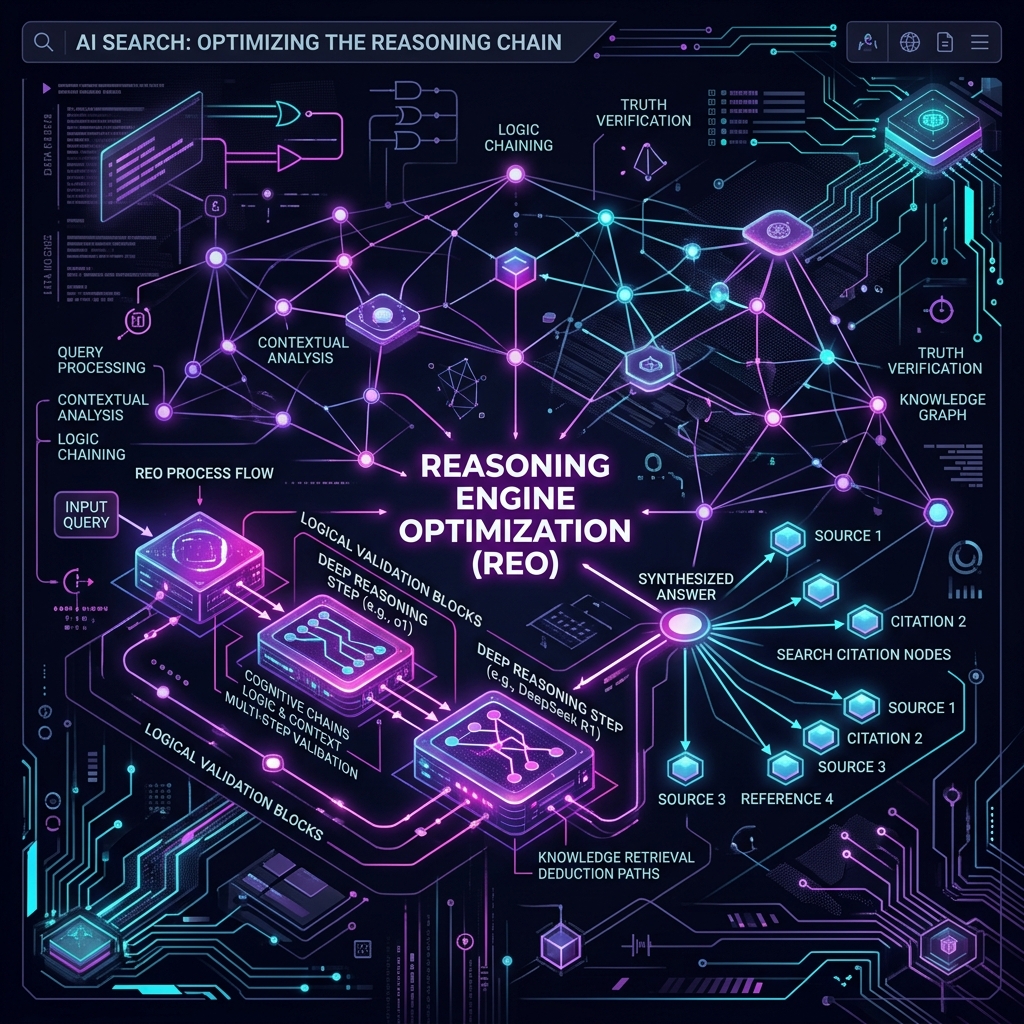
To optimize for REO, you must understand how reasoning models ingest, evaluate, and cite web documents. Unlike standard models, reasoning models run internal validation loops before outputting an answer.
graph TD
    A[User Submits Complex Query] --> B[AI Triggers Live Web Retrieval]
    B --> C[Reasoning Chain-of-Thought Evaluates Source Quality]
    C --> D[Contradiction & Claim Verification Loop]
    D --> E[Factual Consensus Compilation]
    E --> F[Synthesis and Numbered Citation Output]
1. Intent Transformation & Web Search
The system breaks down complex queries into precise multi-hop search strings, fetching high-ranking documents from the web using partner indexes and direct crawlers.
2. Chain-of-Thought Evaluation
During the thinking phase, the model parses the retrieved pages. It doesn't just read the text; it evaluates the claims, looking for logical consistency, detailed evidence, and structural clarity.
3. Contradiction Filtration
Reasoning models compare claims across different retrieved pages. If your page makes a claim that contradicts the verified consensus without providing evidence, the reasoning engine will exclude it from the final citation set.
4. Factual Synthesis & Attribution
Finally, the model synthesizes the answer, generating markdown tables or lists and attaching precise citations linking directly to the source pages that survived the validation process.
Key Strategies for Reasoning Engine Optimization (REO)
To build a high-authority digital footprint that reasoning models trust and cite, focus on these three core strategies:
1. Optimize for Chain-of-Thought Parsers (The Proof-First Protocol)
Reasoning engines look for evidence. Instead of writing general claims, state your point and immediately back it up with quantitative data, step-by-step logic, or verified benchmarks.
- The Tactic: Structure your sections using the Proof-First Protocol: State the claim, list the supporting metrics, and explain the methodology. Use Vect AI's SEO Content Strategist to structure your articles for reasoning parsers.
2. Format with Structured Markdown Tables
Because reasoning models excel at logical comparison, they rely heavily on markdown tables to synthesize options for users.
- The Tactic: Summarize features, specs, pricing, and workflows in clean tables. This makes it easier for the reasoning model to extract facts during its thinking phase and output them as a citation.
3. Align with Industry Entity consensus
Reasoning models verify facts against their internal knowledge graphs. To build trust, align your descriptions with established industry entities.
- The Tactic: Map your integrations and platform comparisons clearly. For instance, describe how Vect AI coordinates with major CRMs (like HubSpot and Salesforce) to automate GTM operations. Connect these concepts using our Brand Voice Architecture.
The REO Deployment Checklist
Ensure your content is optimized for reasoning search engines:
[ ]Logical Structure: Structure articles with hierarchical H2/H3 headings and immediate answers.[ ]Quantitative Evidence: Back up major claims with statistics, percentages, or step-by-step proofs.[ ]Structured Markdown Tables: Include at least one comparison or data table per article.[ ]Verify Semantic Links: Connect content to cornerstone platform guides like Agentic SEO Playbook and Campaign Builder Guide.[ ]Validate Schema Markup: Ensure your FAQ and Article JSON-LD schemas are correctly configured.
Conclusion
As search engines shift from simple retrieval to deep reasoning, traditional keyword strategies are no longer sufficient. By structuring your content with logical proofs, clear tables, and factual consistency, you ensure your brand is cited as a trusted authority by reasoning-based search models.
Ready to optimize your site for reasoning engines?
Log into Vect AI, open the SEO Content Strategist, and build an automated content engine optimized for o1, o3-mini, and DeepSeek-R1 today.
Stop Reading. Start Scaling.
You have the blueprint. Now you need the engine. Launch the AI agent for "SEO Content Strategist" and get results in minutes.
Launch SEO Content Strategist