
Search is no longer about blue links. It is about citation supremacy.
In 2026, the way users search for information has undergone a massive paradigm shift. Over 50% of high-intent B2B search traffic is now captured not by traditional Google search result pages, but by AI answer engines like Perplexity, ChatGPT Search, and Google AI Overviews. If your content strategy is still optimized purely for traditional keyword density, you are invisible to the engines that matter.
To capture the next generation of organic traffic, you must pivot to Answer Engine Optimization (AEO) and implement a dedicated Perplexity SEO Strategy.
Perplexity does not just index keywords; it synthesizes consensus. It reads, extracts, and cites. To win, your content must be structured as the ultimate, indisputable source of truth.
In this guide, we will break down the mechanics of Perplexity's retrieval engine and outline the exact playbook to ensure your brand becomes the primary cited authority using Vect AI.
What is Perplexity SEO?
Perplexity SEO (a core component of Generative Engine Optimization) is the process of optimizing web content to be successfully retrieved, synthesized, and cited by Perplexity AI’s answer engine.
Unlike traditional search, where ranking #1 gets you a blue link, ranking on Perplexity means becoming a cited reference number (e.g., [1], [2]) in the conversational summaries read by users.
Traditional SEO vs. Perplexity AEO
| Metric / Feature | Traditional SEO (Google) | Perplexity AEO (Answer Engine) |
|---|---|---|
| Search Paradigm | Keyphrase matching & PageRank | Semantic intent & multi-source synthesis |
| Search Result | List of links (10 Blue Links) | Fused AI paragraph with numbered citations |
| Indexing Speed | Days to weeks | Real-time web retrieval |
| Content Focus | Keyword volume & word count | Factual density, clarity, and structured lists |
| Conversion Vector | Direct site click | Clickable source numbers & follow-up suggestions |
How Perplexity's Retrieval Loop Works
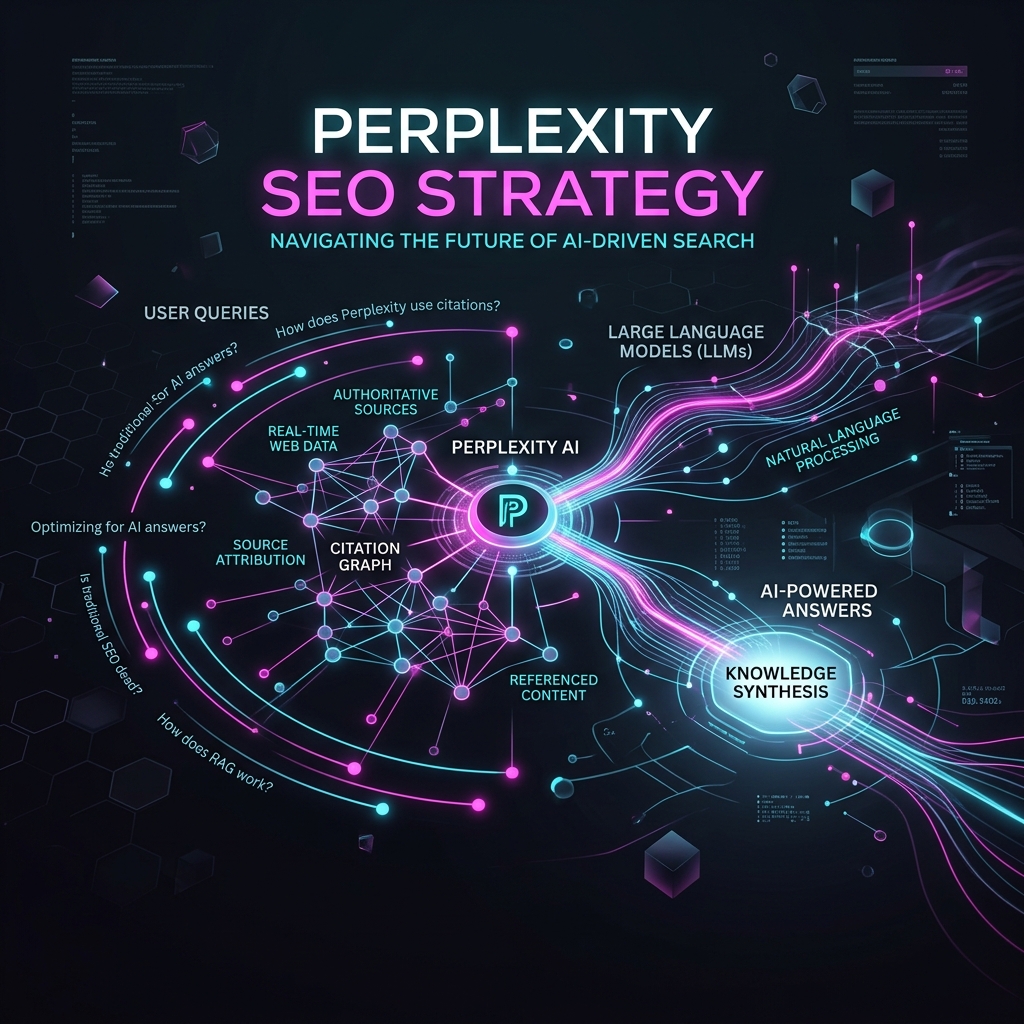
To optimize for Perplexity, you must first understand how its engine processes a query in real-time. Perplexity does not just pull from a static offline index; it executes a live web-search, pulls relevant documents, and summarizes them on the fly.
Here is the exact lifecycle of a Perplexity search query:
graph TD
    A[User Enters Query] --> B[Perplexity Generates Search Intent]
    B --> C[Real-Time Crawl: PerplexityBot Fetches Top Pages]
    C --> D[Model Evaluates: Relevancy & E-E-A-T Check]
    D --> E[Synthesis: AI Compiles the Direct Answer]
    E --> F[Attribution: Citations Generated & Linked to Sources]
1. Intent Transformation
Perplexity takes conversational, natural language questions (e.g., "How do I scale cold emails using AI agents without getting blacklisted?") and converts them into structured search queries to query the live web.
2. Live Web Retrieval
Perplexity queries search indexes and deploys its crawlers (like PerplexityBot) to pull the top 10–20 most relevant pages instantly. If your site blocks these bots or suffers from slow load times, you are instantly disqualified.
3. Factual Extraction & Consensus Matching
The AI reads the retrieved documents. It filters out fluff, jargon, and keyword stuffing, actively looking for structured tables, bullet points, and direct answers to the user's core question. It also looks for consensus: if multiple authoritative domains state the same facts, those facts are prioritized.
4. Synthesized Answer & Citation
The model generates the final text. For every key claim it makes, it appends a citation link pointing directly to the source page that provided that information.
The Complete Perplexity SEO Playbook
Here is how to optimize your content programmatically to dominate Perplexity citations.
1. Craft the "Definition Hook"
Perplexity looks for concise summaries to extract as direct snippets.
- The Tactic: In the first 100 words of your article, directly answer the target question in 2–3 clear, highly factual sentences.
- Example: "Agentic SEO is the use of autonomous AI agents to research, write, and optimize content. It differs from traditional SEO by executing continuous self-improving loops..."
2. Structure for AI Extraction (Tables and Lists)
LLMs are highly efficient at parsing structured data. Articles containing clear tables, step-by-step lists, and descriptive H2/H3 headers receive significantly higher citation rates.
- The Tactic: Always include a comparison table, structured key takeaways, or sequential steps. Use markdown tables (
| Column 1 | Column 2 |) to present data cleanly.
3. Establish Off-Site Authority and Consensus
Perplexity values what other sites say about you. It searches Reddit, Quora, industry directories, and news outlets to cross-reference brand authority.
- The Tactic: Ensure your brand is active and cited across third-party channels. Use Vect AI's Competitor Strategy Spy to discover where your competitors are mentioned and match their footprint.
4. Run an Aggressive Freshness Loop
Because Perplexity fetches real-time data, newer content and updated metadata tags often take priority over older, static authority pages.
- The Tactic: Use Vect AI's SEO Content Strategist to continuously monitor high-performing articles and programmatically refresh them with current statistics, dates, and updated JSON-LD schema every 60 days.
The Perplexity SEO Optimization Checklist
Ensure your content meets these parameters before hitting publish:
[ ]Crawler Access: Verify that yourrobots.txtexplicitly allowsPerplexityBotand generic AI search crawlers.[ ]Direct Answer Box: Place a highly concise, factual 2-sentence answer immediately under the first H1 or H2 header.[ ]Structural Markups: Ensure schema markup (BlogPostingandFAQPage) is fully configured for search crawlers.[ ]Zero Fluff: Edit out long winded introductions. AI filters out conversational filler and rewards direct, informative prose.[ ]Actionable Call-to-Action: Link users to an interactive tool (e.g. diagnosing their search profile with our AI Content Gap Finder).
Conclusion
Ranking on Perplexity and other AI answer engines is not about playing keyword games; it is about providing the most accurate, structured, and authoritative answer on the web. By focusing on Answer Engine Optimization (AEO), you position your brand at the absolute center of the next generation of search.
Ready to automate your AEO and dominate AI search citations?
Log into Vect AI, open the SEO Content Strategist, and build your automated Perplexity authority engine today.
Stop Reading. Start Scaling.
You have the blueprint. Now you need the engine. Launch the AI agent for "SEO Content Strategist" and get results in minutes.
Launch SEO Content Strategist