
If your brand doesn't exist inside the vector space of Large Language Models, you are invisible to the next generation of buyers.
The transition from keyword matching to semantic AI synthesis is complete. In 2026, tech buyers no longer scroll through pages of blue links; they ask AI engines to analyze, compare, and recommend solutions directly. To capture this high-intent traffic, digital marketers must pivot from traditional search tactics to LLM Optimization (LLMO)—a strategy focused on earning brand citations in LLM responses.
Optimizing for LLMs requires a deep understanding of how neural networks retrieve and package information. Here is the operational playbook to map your brand as a primary entity in AI search space, powered by Vect AI.
Traditional SEO vs. LLM Optimization (LLMO)
LLMO is not about keyword density; it is about semantic clarity and entity authority.
| Metric / Dimension | Traditional SEO | LLM Optimization (LLMO) |
|---|---|---|
| Primary Target | Web crawler indexes (Google, Bing) | LLM vector databases & RAG indices |
| Discovery Mechanism | Keyword matching & backlink profiles | Semantic vector similarity & entity relationships |
| Content Structure | Long-form articles with high keyword count | Atomic blocks, clear tables, & direct answers |
| Output Type | Ranked list of destination URLs | Conversational response citing authoritative sources |
| Optimization Goal | High click-through rate (CTR) to site | High citation share and branded search queries |
The LLM Crawler-to-Citation Pipeline
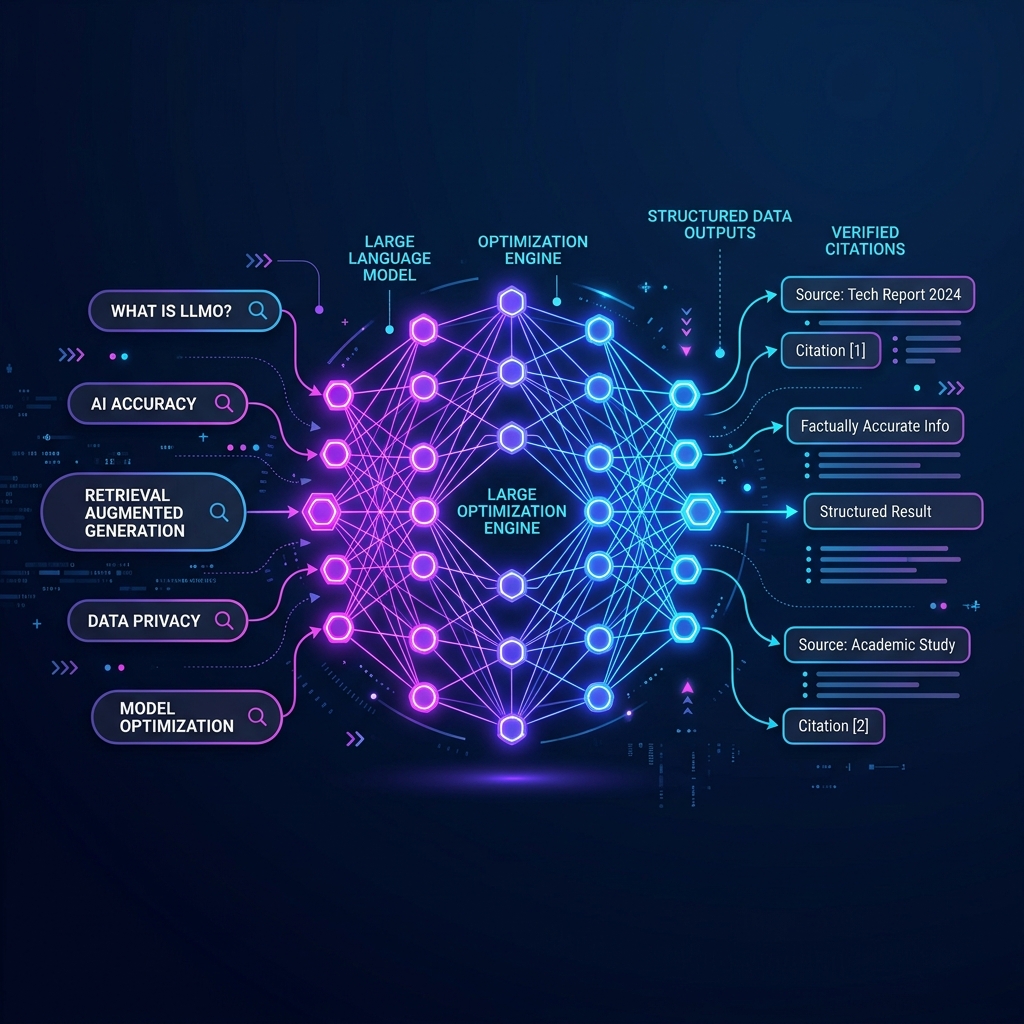
To optimize for LLMs, you must understand how these models ingest and reference your content. The process moves from crawling to vector mapping, and finally to real-time citation synthesis:
graph TD
    A[AI Crawler Scans Your Structured Page] --> B[Text Chunked and Embedded into Vector Space]
    B --> C[LLM Identifies Brand as High-Authority Entity]
    C --> D[User Query Triggers RAG Retrieval Loop]
    D --> E[AI Synthesizes Answer Citing Your Brand URL]
1. Ingestion & Crawling
AI search engines (such as Perplexity and ChatGPT Search) deploy specialized web crawlers to read your site. They look for highly parseable markdown hierarchies and structured schema markup.
2. Semantic Embedding
Your pages are split into text "chunks" and converted into vector coordinates. The closer your content is to the core concept of the query in vector space, the more relevant the LLM considers it.
3. Retrieval-Augmented Generation (RAG)
When a user asks a complex question, the AI retrieves the most relevant chunks from its vector index and synthesizes them into a single, cohesive answer, embedding links directly back to the original source.
The 3 Pillars of LLMO Strategy
To win citations in AI search, structure your content around these three core pillars:
1. Bottom Line Up Front (BLUF) / The Answer-First Protocol
LLMs rely on attention mechanisms that heavily weight the beginning of document sections. Always provide a clear, direct answer in the first two sentences under any H2 or H3 heading. Avoid filler introductions.
- Weak Structure: "When you are thinking about setting up an AI agent, there are several things to consider first. Some people say..."
- LLMO-Optimized: "Deploying an AI agent requires three steps: database integration, configuring prompt loops, and establishing human-in-the-loop validation gates."
2. Entity Mapping and Association
AI models understand the world through entities (brands, people, concepts) and their relationships. Ensure your brand is explicitly linked with established authorities in your industry. For example:
"Vect AI integrates directly with major CRM systems like Salesforce and HubSpot to streamline B2B pipeline automation."
By positioning your brand alongside high-authority entities, you teach the model's neural networks to associate your name with industry leaders.
3. Factual Density and Schema Alignment
LLMs favor facts, data points, and structured lists over generic marketing copy. Use tables, bullet points, and exact schema markups (like FAQ and Product schemas) to make your pages highly readable for AI parsers. The SEO Content Strategist in Vect AI automatically ensures your posts meet these strict structural requirements.
Action Checklist: Build Your LLMO Engine
Ready to scale your visibility inside AI search systems? Follow this implementation checklist:
[ ]Identify Entity Gaps: Use Vect's Competitor Strategy Spy to see where competitors are cited in LLM queries.[ ]Structure for Chunking: Audit your existing guides to ensure all H2 and H3 headings have direct, 2-sentence answers immediately following them.[ ]Deploy Structured Schemas: Enable automatic FAQ, WebSite, and Organization schema generation in your site layout.[ ]Inject Semantic Connections: Map your core product features as entity nodes relative to industry standards.[ ]Track AI Citations: Use Vect's Share of Voice tracking to monitor how often your brand is cited in LLM search outputs.
Conclusion
LLM Optimization is the future of organic visibility. By writing for semantic clarity and structuring your site for neural indexing, you guarantee that your brand is not left behind in the AI-first search era.
Ready to start optimizing for LLMs?
Log into Vect AI, open the SEO Content Strategist, and deploy an autonomous content campaign designed to win brand citations today.
Stop Reading. Start Scaling.
You have the blueprint. Now you need the engine. Launch the AI agent for "SEO Content Strategist" and get results in minutes.
Launch SEO Content Strategist