
Search has evolved from a list of links to a synthesized answer engine. If your site isn't structured to feed Google's LLM, your organic traffic will disappear.
In 2026, Google AI Overviews (AIO) dominate the search landscape, answering complex, multi-hop queries directly on the search engine results page (SERP). For B2B SaaS companies, this means the traditional playbook of optimizing purely for keyword density is obsolete. To survive, you must pivot to Generative Engine Optimization (GEO) and optimize for extraction.
When Google generates an AI Overview, it selects a small cohort of web pages to synthesize, adding link cards and inline citations. If your content is not structured as an authoritative, easily digestible source of truth, the crawler will skip your domain.
In this guide, we break down how Google's AI Overview retrieval loop functions and outline the exact optimization strategies to secure citations using Vect AI.
Traditional Search vs. AI Overviews
Winning in the generative search landscape requires adapting to a new set of ranking dimensions.
| Dimension | Traditional Search (Google Blue Links) | Google AI Overviews (AIO) |
|---|---|---|
| User Intent | Single keywords or short phrase queries | Conversational, long-tail, and multi-part questions |
| Result Format | Ten blue links with meta snippet descriptions | AI-generated summary with inline citations and product grids |
| Retrieval Speed | Pre-computed database index lookup | Real-time web retrieval combined with RAG synthesis |
| Ranking Focus | PageRank, backlink quantity, keyword match | Information density, factual accuracy, E-E-A-T, and structure |
| CTR Dynamics | High CTR on position #1 to #3 links | Compressed CTR overall, but highly qualified clicks from citation cards |
The Google AI Overviews Retrieval Loop
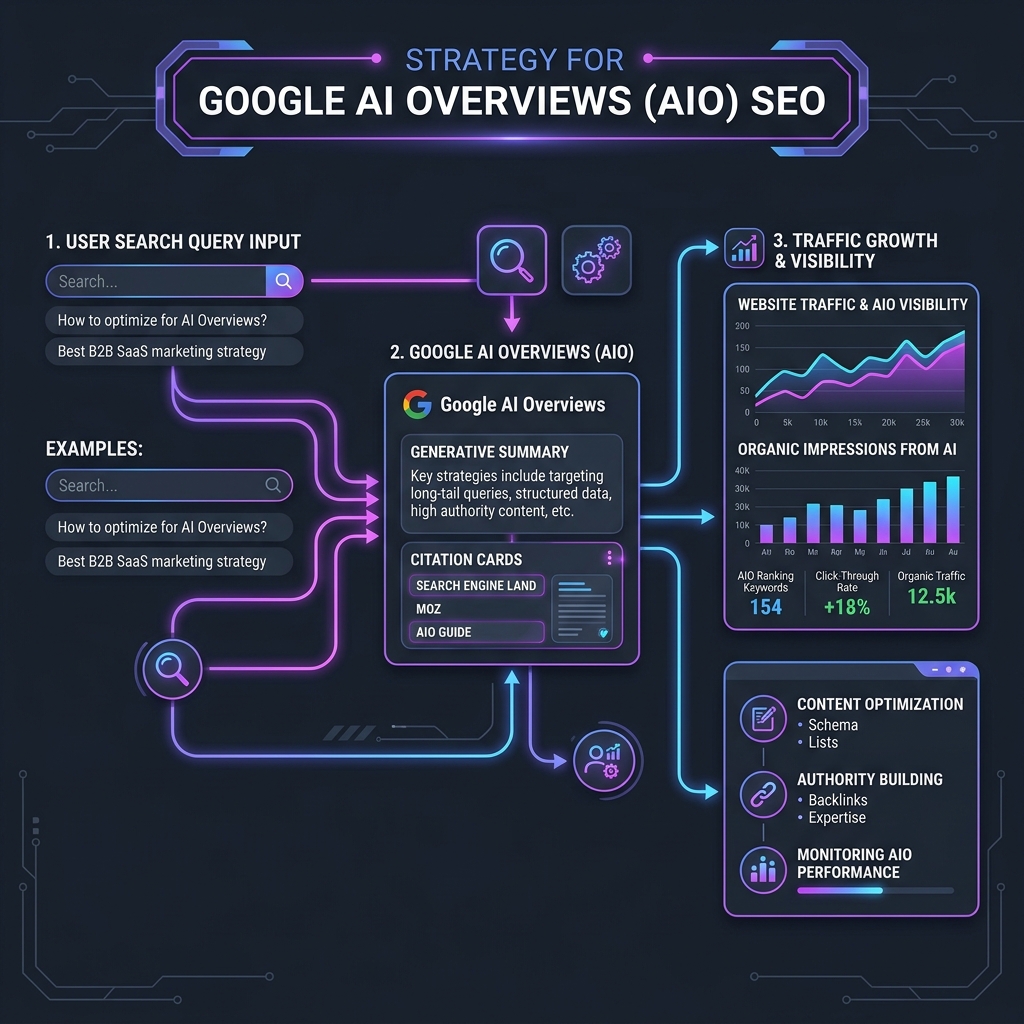
To rank in AI Overviews, your content must successfully pass through Google's multi-stage retrieval and validation pipeline.
graph TD
    A[User Submits Complex Query] --> B[Google Core Systems Rank Top Organic Web Pages]
    B --> C[AIO Ingestion: Parser extracts facts from top-ranking pages]
    C --> D[E-E-A-T & Quality Check: Filters out low-trust content]
    D --> E[RAG Generation: Gemini synthesizes the consolidated answer]
    E --> F[Attribution Layout: Populates link cards and citation tags]
1. The Core Ranking Entry Ticket
Google does not choose sources at random. AI Overviews are grounded in search results generated by Google's core ranking systems. If your site does not already rank in the top 10 organic positions for a query, it is highly unlikely to be cited in the AI Overview.
2. Ingestion & Fact Extraction
Once the top pages are pulled, Google's semantic parser ingests the content. It bypasses HTML boilerplate, looking specifically for direct answer blocks, definitions, structured tables, and comparison grids.
3. Synthesis & Grounding
Google's Gemini model synthesizes the final response. During this stage, the model cross-references facts across multiple sources. Pages that align with the consensus of authoritative sites are cited more frequently.
The AI Overviews SEO Optimization Blueprint
Implement these core pillars to optimize your website for AI Overview integration.
1. Build the "Gemini-Ready" Definition Block
Google’s generative engine relies heavily on concise definitions to answer "What is..." or "How to..." questions.
- The Tactic: Place a direct, factual answer of 45-60 words immediately below your main H1 or first H2 header. Avoid using promotional jargon.
- Example: "Google AI Overviews SEO is the practice of structuring web content so that Google's generative search engine can easily extract and cite it as a source in its AI-synthesized responses."
2. Format Content for Maximum Extractability
LLMs struggle to parse dense, unstructured paragraphs. They prioritize clear structural elements.
- The Tactic: Convert complex processes into step-by-step ordered lists. Use Markdown tables to compare features, pricing, or metrics. Google routinely pulls these tables directly into the AI Overview interface.
3. Demonstrate Extreme E-E-A-T
Google filters out unverified AI-generated content. You must show real-world experience.
- The Tactic: Include original case studies, data points, author bios, and expert quotes. With Vect AI's SEO Content Strategist, you can structure your posts with standard entity schemas that prove your brand's expertise to Google's crawlers.
4. Continuous Content Refresh Cycles
AI search prioritizes fresh, up-to-date resources for trending keywords.
- The Tactic: Review your top-performing organic pages every quarter. Use Vect AI's Market Signal Analyzer to detect query shifts and automatically refresh your statistics, FAQs, and publishing dates to maintain topical freshness.
AI Overviews SEO Checklist
Use this checklist to prepare your blog posts for Google's AI crawlers:
[ ]Top-10 Organic Standing: Focus on target keywords where you already have or can easily build organic traction.[ ]Direct Answer Box: Add a highly concise, factual 2-sentence summary right after the first heading.[ ]Structured Data Tables: Use Markdown tables to present comparative details.[ ]Embed FAQ Schema: Ensure your MDX or JSON-LD frontmatter includes a structured FAQ block to answer long-tail questions.[ ]No Filler content: Cut out conversational fluff and get straight to the value.
Conclusion
Succeeding in Google's AI Overview era is not about finding hacks or hidden tags. It is about aligning with Google’s goal: providing searchers with the clearest, most accurate, and most authoritative answer. By structuring your content for extraction and maintaining high authority, you position your business to capture high-value organic clicks from AI citation cards.
Ready to claim your share of voice in AI search?
Log into Vect AI, open the SEO Content Strategist, and build your entity-driven authority engine today.
Stop Reading. Start Scaling.
You have the blueprint. Now you need the engine. Launch the AI agent for "SEO Content Strategist" and get results in minutes.
Launch SEO Content Strategist