
Optimizing for search engines is no longer about Google alone. Welcome to the era of ChatGPT Search.
In 2026, OpenAI's conversational search interface has captured a significant share of high-value search queries. When users search for tools, guides, reviews, and step-by-step solutions, they are increasingly asking ChatGPT instead of browsing traditional search engine result pages.
To win traffic in this landscape, your site must rank inside ChatGPT's real-time retrieval network.
If you are not cited in ChatGPT's conversational outputs, your brand does not exist to millions of users.
In this comprehensive playbook, we will detail how ChatGPT Search works and provide the exact Answer Engine Optimization (AEO) strategies to ensure your content is indexed, cited, and clicked using Vect AI.
What is ChatGPT Search SEO?
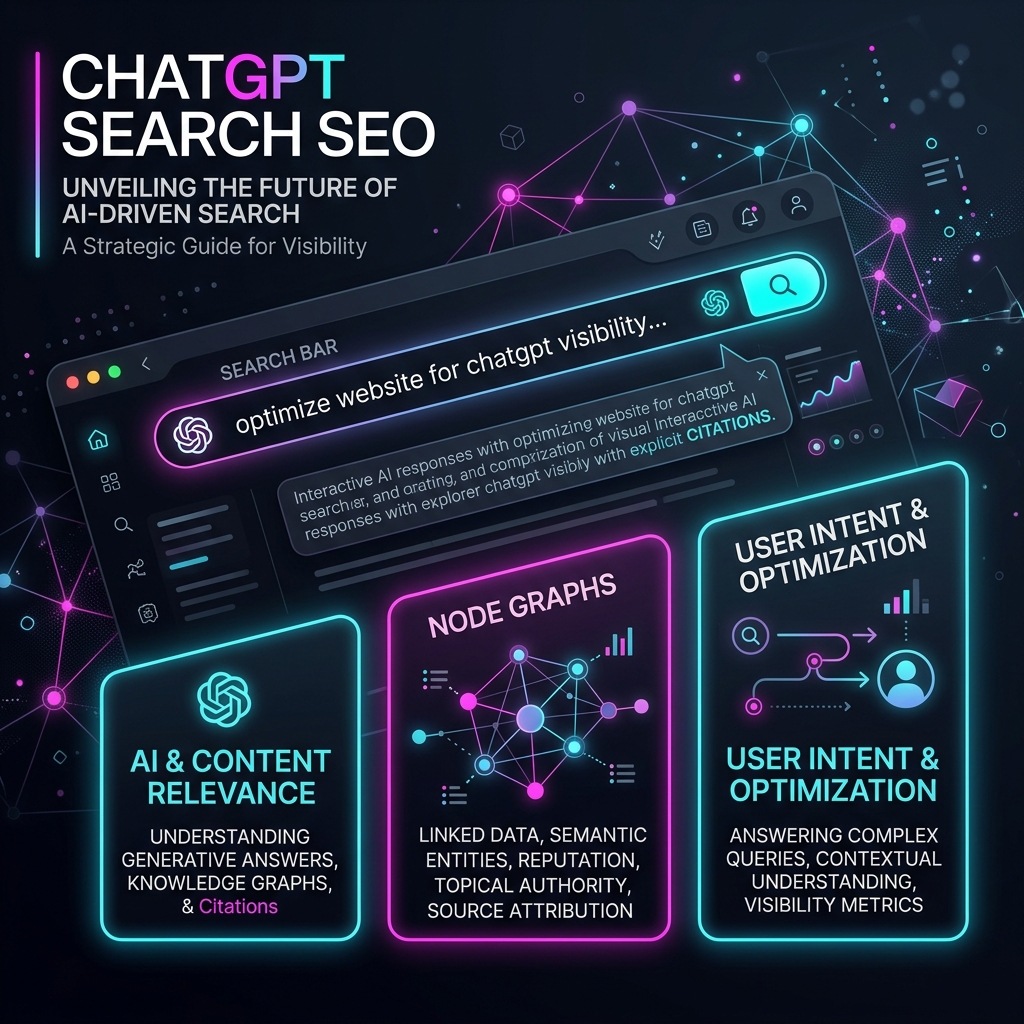
ChatGPT Search SEO is the practice of optimizing digital content so that OpenAI’s language models retrieve and cite it when answering user queries in real-time.
Instead of displaying a list of blue links, ChatGPT synthesizes a conversational paragraph using multiple web sources, appending tiny citation links directly to the text. To capture this traffic, you must structure your content to be the easiest to extract and the most authoritative consensus source on the web.
Google Search vs. ChatGPT Search
| Optimization Pillar | Traditional Google SEO | ChatGPT Search SEO |
|---|---|---|
| Primary Index | Googlebot Web Index | OAI-SearchBot & Bing Index |
| Result Format | Blue Links & Snippets | Conversational Summary with Citations |
| Ranking Signal | PageRank, Backlinks, Content Length | Entity Trust, Consensus, Factual Density |
| Core Formatting | Keyword density, H2s/H3s | BLUF (Bottom Line Up Front), Tables, Q&A |
| User Interaction | One-shot search & click | Multi-turn chat, follow-ups, deep links |
How ChatGPT Search Retrieves and Cites Information
To rank in ChatGPT Search, you must understand how the model processes user queries and selects sources. It is not just about having high domain authority; it is about providing the most synthesis-ready information.
Here is how ChatGPT Search executes a query:
graph TD
    A[User Types Chat Query] --> B[ChatGPT Rewrites to Search Terms]
    B --> C[Real-Time Retrieval: Bing API & OAI-SearchBot Fetch Pages]
    C --> D[Context Compression: Key Facts Extracted from Top Pages]
    D --> E[Synthesis: GPT Model Generates Conversational Answer]
    E --> F[Attribution: Citations Generated & Linked to Sources]
1. Query Expansion & Translation
ChatGPT takes complex, conversational queries (e.g., "Which is better for B2B lead generation: Clay or Vect AI?") and translates them into keyword-based search queries to fetch relevant live data from the web.
2. Multi-Source Web Retrieval
The search engine queries partner networks (mainly Bing) and uses its own scraper, OAI-SearchBot, to retrieve high-ranking pages. Sites that block OAI-SearchBot or have slow server responses are ignored.
3. Factual Extraction
ChatGPT's context window is limited. It reads the top web pages and extracts only the most dense, factual, and structurally clear paragraphs. It ignores marketing fluff, generic intros, and page-filling text.
4. Consensus & citation
The model synthesizes the final answer. To build trust, it highlights facts that are verified across multiple high-authority sources, creating links back to the original URLs.
The ChatGPT Search SEO Playbook
Here is how to optimize your content programmatically for OpenAI's search ecosystem.
1. Adopt the BLUF Framework (Bottom Line Up Front)
ChatGPT prefers pages that answer the searcher's query instantly.
- The Tactic: Place the direct answer to your target keyword's query in the very first sentence or paragraph of your page. Do not bury the lede. Use clean, declarative English.
- Example: "ChatGPT Search SEO is the process of optimizing web pages to rank as citations inside OpenAI's ChatGPT. It requires structured HTML, factual consensus, and allowing OAI-SearchBot."
2. Format with Tables and Listicles
Large language models are trained to parse structured data structures like tables and lists much faster than dense blocks of paragraph text.
- The Tactic: Use comparison tables, ordered lists, and clear bullet points to present key data. When summarizing competitor pricing or feature comparisons, format it cleanly in markdown.
3. Build Off-Site Consensus (Reddit, LinkedIn, Reviews)
ChatGPT crawls community networks to establish entity authority and brand sentiment.
- The Tactic: Do not just optimize your own site. Ensure your brand is mentioned positively on Reddit, Quora, and major industry review portals. ChatGPT uses these platforms to verify consensus.
4. Keep Content Fresh & Crawler Accessible
OpenAI search relies on rapid index updates to provide real-time information.
- The Tactic: Always allow
OAI-SearchBotandBingbotin yourrobots.txt. Regularly update key statistics, facts, and dates, and publish these updates to your dynamic sitemap.
The ChatGPT Search SEO Checklist
Verify these steps before launching your SEO campaign:
[ ]Crawler Verification: EnsureOAI-SearchBotis not blocked in your website'srobots.txtconfiguration.[ ]BLUF Answer Box: Place a clear, direct 2-3 sentence definition at the top of the post.[ ]Structured Markdown Tables: Present comparisons or specs in clean markdown tables.[ ]Entity Association: Explicitly link concepts back to target platform guides (like our Brand Voice Architecture).[ ]Dynamic Sitemap Enrollment: Add new slugs to sitemap.ts immediately for indexing.
Conclusion
Success in ChatGPT Search is determined by trust, structure, and direct utility. By optimizing your site for extraction and providing structured, authoritative data, you capture high-intent search traffic directly from conversational search.
Ready to programmatically scale your SEO for AI Search?
Log into Vect AI, configure the SEO Content Strategist, and build an automated content engine that ranks across ChatGPT, Perplexity, and Google.
Stop Reading. Start Scaling.
You have the blueprint. Now you need the engine. Launch the AI agent for "SEO Content Strategist" and get results in minutes.
Launch SEO Content Strategist