
If your business is still relying on manual marketing processes or outdated, rules-based software, you are losing ground to competitors who have embraced agentic AI.
The digital landscape of 2026 is hyper-competitive. Consumers are bombarded with generic messaging, and algorithms prioritize high-quality, continuous content output. To cut through the noise and achieve massive scale, forward-thinking companies are deploying the best AI marketing automation tools available. These platforms are not just efficiency boosters; they are fundamental drivers of unprecedented business growth.
In this definitive guide, we will explore exactly how AI marketing automation tools supercharge your social media growth and lead generation pipelines. We will unpack the transition from static automation to autonomous, agentic workflows, and provide a deep-dive comparison of industry-leading platforms—specifically analyzing how Vect AI stacks up against established giants like ActiveCampaign and GetResponse.
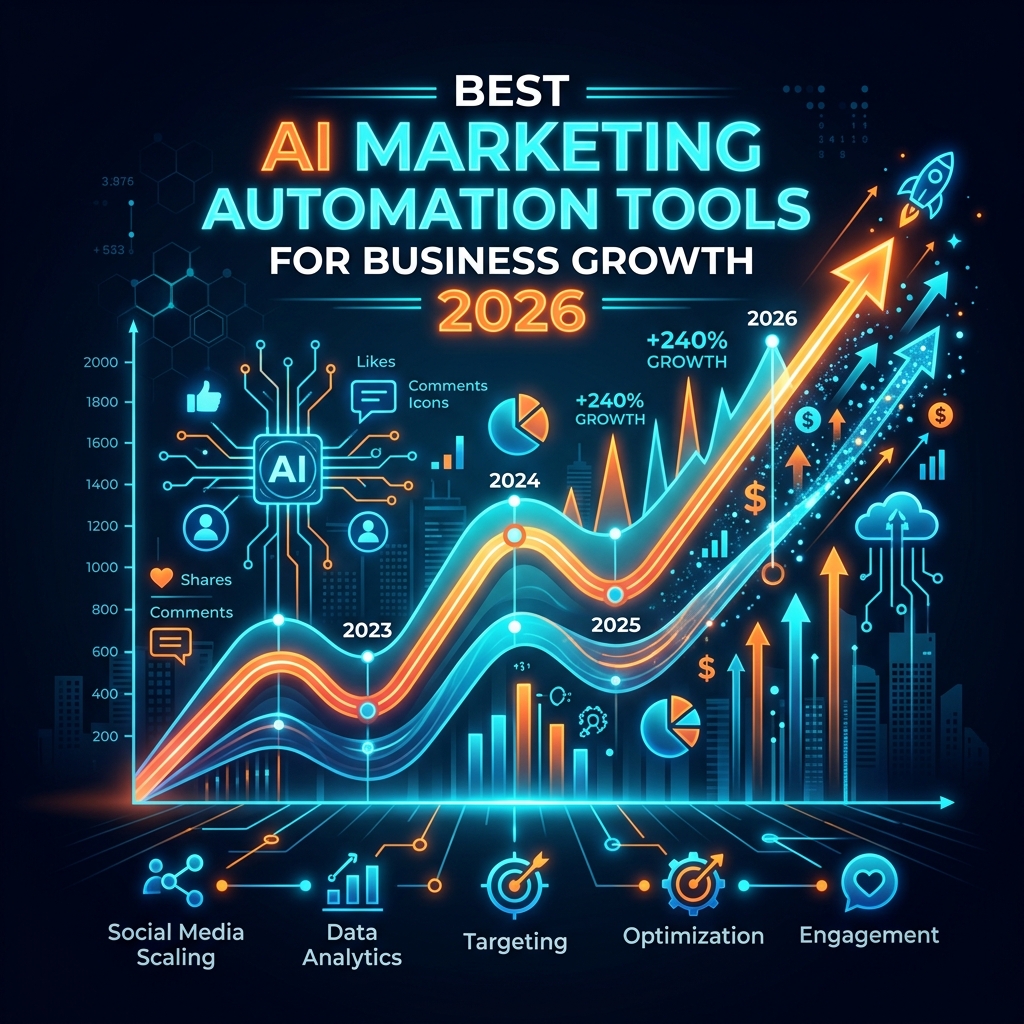
The Evolution of Marketing Automation: From Static to Agentic
To understand the true value of the best AI marketing automation tools in 2026, we first need to define what they actually are, and more importantly, what they are not.
The Limitations of Traditional Automation
For the past decade, platforms like Mailchimp, ActiveCampaign, and HubSpot defined "automation" as a series of IF/THEN statements. If a user downloads an eBook, then send them Email A. If they don't open Email A in three days, send them Email B.
While this saved marketers time, it had critical limitations:
- The Human Bottleneck: A human still had to write Email A and Email B.
- Static Logic: The system couldn't adapt. If the user's intent shifted, the automation broke or became irrelevant.
- Siloed Channels: Email automation rarely spoke seamlessly to social media advertising or website personalization without complex, fragile integrations.
The Rise of Agentic AI Systems
The best AI marketing automation tools today are agentic. They don't just execute pre-programmed paths; they act as autonomous digital employees.
An agentic platform uses advanced Large Language Models (LLMs) and real-time data analysis to understand a high-level goal and independently figure out the steps to achieve it. Instead of saying, "Send this specific email at 9 AM," you tell an AI agent, "Generate 100 high-intent leads from the cybersecurity sector this month."
The AI system will then autonomously:
- Research trending topics in cybersecurity.
- Draft highly personalized outbound emails based on recent company news.
- Generate and schedule engaging LinkedIn posts to build brand awareness.
- Monitor responses and adjust the messaging based on performance data.
This shift from execution to autonomy is the defining characteristic of marketing software in 2026.
Accelerating Business Growth with AI Marketing Automation Tools
Why are businesses rushing to integrate these platforms? The answer is simple: unparalleled ROI and scalable growth. Let's break down the primary mechanisms by which AI marketing automation tools drive revenue.
1. Scaling Operations Without Bloated Headcount
Historically, scaling a business meant scaling the workforce. If you wanted to double your marketing output, you needed to hire more writers, designers, and campaign managers. This linear growth model is expensive and difficult to manage.
AI marketing automation tools act as a massive force multiplier. A single marketer equipped with a platform like Vect AI can orchestrate campaigns that would typically require a ten-person team. The AI handles the heavy lifting—data analysis, copywriting, graphic generation, and cross-channel deployment—freeing your human talent to focus on high-level strategy, relationship building, and product development.
2. Autonomous Lead Generation and Nurturing
Consistent lead generation is the engine of business growth. However, manual prospecting is notoriously inefficient. The best AI marketing automation tools continuously monitor the digital landscape for buying signals.
By leveraging capabilities detailed in the AI Lead Generation Guide, these tools can identify when a target account exhibits intent—perhaps they received funding, hired a new executive, or engaged with a competitor's content. The AI instantly triggers a personalized outreach sequence. Furthermore, it dynamically adjusts the nurture path based on how the prospect interacts, significantly increasing the likelihood of conversion.
3. Delivering Hyper-Personalized Experiences
Generic marketing no longer converts. Modern buyers expect interactions that are tailored to their specific pain points and industry. Achieving this personalization at scale is impossible for human teams but effortless for AI.
AI tools analyze vast datasets to understand individual user preferences. They can dynamically rewrite email copy, alter landing page headlines, and serve specific social media ads based on a user's unique profile. This deep level of personalization builds trust, reduces customer acquisition costs (CAC), and dramatically improves conversion rates.
Dominating Social Media Growth with AI
Social media is a critical component of any growth strategy, but it is incredibly demanding. The algorithms of platforms like LinkedIn, X (Twitter), and TikTok require consistent, high-quality content to maintain visibility. Here is how AI marketing automation tools transform social media from a chore into a growth engine.
1. Infinite Content Generation from the Brand Kernel
One of the biggest hurdles in social media marketing is maintaining brand consistency while scaling output. If you use a generic AI tool like ChatGPT, your posts often sound robotic or disjointed.
Leading platforms solve this through centralized intelligence. For example, Vect AI's Brand Kernel acts as the brain of your marketing operation. You upload your style guides, brand voice, past successful content, and buyer personas into the kernel. From then on, every piece of content the AI generates—whether it's a tweet, a LinkedIn article, or a video script—is perfectly aligned with your brand's unique identity.
2. Trendjacking and Real-Time Signal Analysis
Social media moves at lightning speed. Capitalizing on a trending topic can result in massive organic reach, but identifying these trends manually is difficult.
AI tools continuously scan social feeds, news outlets, and industry forums for emerging market signals. When a relevant trend is detected, the AI can alert your team and autonomously draft a highly relevant, context-aware post. This allows your brand to participate in critical conversations as they happen, capturing a disproportionate share of voice.
3. Automated Video and Visual Production
Video content dominates social media engagement. However, producing video is resource-intensive. AI marketing automation tools now feature integrated video generation capabilities.
By utilizing tools like the AI Viral Video Script Generator, marketers can input a core topic, and the AI will produce a high-retention script, generate storyboards, and even assist in creating the final short-form video asset. This democratizes high-quality video production, enabling rapid social media growth.
Comparing the Best AI Marketing Automation Tools: Vect AI vs. ActiveCampaign vs. GetResponse
To truly understand the landscape, we must compare the leading platforms. While ActiveCampaign and GetResponse are industry stalwarts, Vect AI represents the new wave of agentic automation. Let's explore how they stack up.
1. ActiveCampaign: The Rules-Based Powerhouse
ActiveCampaign is a phenomenally powerful platform for traditional email marketing, CRM integration, and complex, logic-based automations. It is widely regarded as one of the best tools for managing customer journeys once a user is already in your ecosystem.
Where ActiveCampaign Excels:
- Highly complex, visual automation builders (IF/THEN/ELSE logic).
- Deep CRM functionality and lead scoring.
- Granular tracking of user behavior on your website to trigger specific emails.
Where it Falls Short: ActiveCampaign relies entirely on human input for content creation. You must write every email, design every graphic, and map every single step of the workflow. It executes brilliantly, but it does not create or think autonomously.
2. GetResponse: The All-in-One Marketing Hub
GetResponse has evolved from a simple email marketing tool into a comprehensive platform offering webinar hosting, landing page builders, and e-commerce integrations. It is an excellent choice for small businesses looking for a "Swiss Army knife" approach.
Where GetResponse Excels:
- Built-in webinar hosting and automated funnels (Conversion Funnels).
- Easy-to-use landing page and email builders.
- Solid e-commerce integrations for automated abandoned cart emails.
Where it Falls Short: Like ActiveCampaign, GetResponse's "AI" features are mostly limited to basic subject line generation or simple text rewriting. It does not possess the agentic capabilities to autonomously research trends, generate cross-channel campaigns, or act as an independent digital marketer.
3. Vect AI: The Autonomous Marketing Operating System
Vect AI is fundamentally different. It is not just a tool for sending emails; it is an agentic marketing operating system designed to drive holistic business and social media growth.
Where Vect AI Wins:
- Agentic Autonomy: Using the Campaign Builder, you simply define your objective (e.g., "Increase LinkedIn engagement by 30% targeting B2B SaaS founders"). Vect AI's Orchestrator Agent designs the strategy, drafts the content, and schedules the deployment autonomously.
- The Brand Kernel: Unlike generic generative AI, Vect AI ensures 100% brand consistency. Every agent references your unique Brand Kernel, ensuring all output sounds exactly like your brand, not a robot.
- Cross-Channel Native Generation: Vect AI doesn't just manage email. It natively generates and deploys content for LinkedIn, X, blogs, and ad platforms, ensuring a unified, omnichannel presence.
- Signal-Based Selling: Vect AI actively monitors the web for buying signals, automatically triggering hyper-personalized outreach the moment a prospect shows intent.
While ActiveCampaign and GetResponse are tools you use, Vect AI is a team member you employ. (For more comparisons, explore our guides on Vect vs HubSpot and Vect vs Salesforce).
Actionable Steps: How to Implement Agentic Automation Today
Ready to transform your marketing strategy and accelerate your business growth? Follow this script to deploy your first autonomous campaign using Vect AI. It is designed to be simple, requiring no technical expertise.
Phase 1: Foundation Setup
  - Log into Vect AI and access the 'Brand Kernel'.
  - Input your brand guidelines: tone of voice, target audience pain points, and core value propositions.
  - Upload 3-5 pieces of your best-performing past content so the AI can learn your style.

Phase 2: Define the Growth Objective
  - Open the 'Campaign Builder'.
  - State your goal clearly in plain English: "Launch an outbound email and LinkedIn campaign to generate leads for our new marketing analytics dashboard."
  - Define the target audience parameters (e.g., Marketing Directors, SaaS companies, $5M+ revenue).

Phase 3: AI Orchestration and Review
  - Click 'Generate Strategy'.
  - Vect AI's agents will instantly research current industry trends and produce a comprehensive campaign timeline.
  - Review the drafted emails and LinkedIn posts. You will notice they perfectly align with the data in your Brand Kernel.

Phase 4: Deployment and Autonomous Optimization
  - Approve the campaign assets and click 'Deploy'.
  - Vect AI will handle the scheduling, sending, and posting.
  - Access the analytics dashboard. The AI will autonomously monitor open rates and engagement, automatically adjusting the follow-up messaging and send times to maximize conversions.
SEO Guidelines & Checklist for Blog Posts
To ensure this post, and all your future content, achieves maximum visibility on Google and AI-driven search engines (like Perplexity and ChatGPT), rigorously adhere to this SEO checklist:
[x]Keywords in Metadata: The primary keyword ("Best AI marketing automation tools") is strategically placed in the title, permalink, and meta description to signal relevance to search engines.[x]Optimize for Generative Engine Optimization (GEO): The content utilizes structured lists, clear definitions, bolded terms, and logical H2/H3 tags. This ensures AI models can accurately parse, understand, and cite the information in their conversational responses.[x]Internal and External Backlinks: We have included essential internal links to the Brand Kernel, Campaign Builder, and relevant comparison guides to create a strong semantic web and keep users engaged within the Vect ecosystem.[x]Natural Language Headings: All H2 and H3 tags are written in simple, conversational terms, directly answering the questions that users and AI voice assistants are actively searching for.[x]Clear Call to Action: The post provides actionable steps (the implementation script) and concludes with a definitive next step, guiding the reader from education to conversion.
The Future Belongs to the Automated
The era of manual, grind-it-out marketing is over. The businesses that will dominate in 2026 and beyond are those that successfully integrate the best AI marketing automation tools into their core operations.
By shifting from static, rules-based software to autonomous, agentic platforms like Vect AI, you empower your organization to scale its output exponentially. You can deliver hyper-personalized experiences to thousands of prospects simultaneously, drive massive social media growth without burning out your team, and ultimately, accelerate your revenue growth.
Do not let your competitors outpace you by adopting this technology first. The future of marketing is automated, intelligent, and highly personalized.
Are you ready to scale your business and dominate your industry?
Sign up for Vect AI, configure your Brand Kernel, and launch your first autonomous campaign in minutes.
Stop Reading. Start Scaling.
You have the blueprint. Now you need the engine. Launch the AI agent for "Campaign Builder" and get results in minutes.
Launch Campaign Builder