
Your attribution software is lying to you. The leads you think are coming from Google search actually originated in places you can't track.
In 2026, the B2B buyer journey is almost entirely invisible. Buyers no longer click on cold ads or fill out multi-stage forms to access whitepapers. Instead, they do their research in private Slack groups, listen to industry podcasts, and ask AI search engines like Perplexity or ChatGPT to recommend solutions.
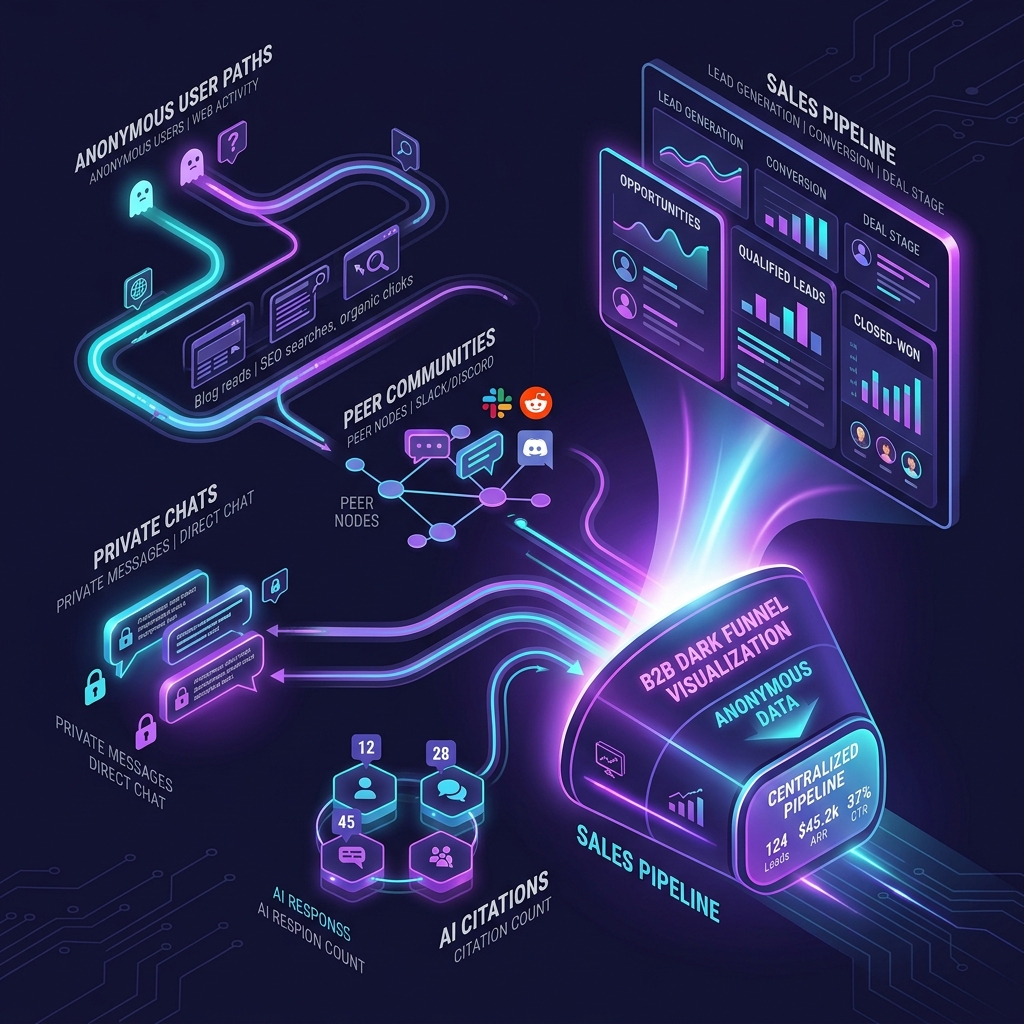
This untrackable space is known as the Dark Funnel.
To scale your pipeline, you must stop trying to force buyers into trackable gates. Instead, you need to align your strategy to capture invisible demand.
In this guide, we explore the mechanics of the B2B Dark Funnel and demonstrate how to optimize your content, tracking, and outbound strategy using Vect AI.
Traditional Attribution vs. Dark Funnel Reality
Most marketing teams are still optimizing for the "Last Click." This leads to incorrect budget allocation and missed pipeline opportunities.
| Metric / Feature | Traditional Attribution (Last-Click) | Dark Funnel Strategy (Intent-Led) |
|---|---|---|
| Primary Goal | Drive trackable page views | Build reputation and topical authority |
| Success Metrics | UTM link clicks & form fills | Branded search & self-reported attribution |
| Content Strategy | Gated PDFs & keyword stuffing | Open research, expert data, & AI citations |
| Channel Focus | Paid search & cookie-tracked ads | Communities, podcasts, social, & AI search |
| Sales Timing | After a form submission | When account-level intent signals trigger |
Mapping the Dark Funnel Journey
To capture invisible demand, you need to understand how dark funnel touchpoints translate into actual pipeline.
Here is the dark funnel conversion path facilitated by Vect AI:
graph TD
    A[Buyer Researches in Private Communities & AI Search] --> B[Brand Recognized as Topical Authority]
    B --> C[Buyer Performs Branded Google Search]
    C --> D[Self-Reported Attribution Captures Source]
    D --> E[Vect AI Enriches and Qualifies Account]
1. The Research Phase
The buyer asks their network or AI engines for recommendations. Because you have optimized for AI search engines, your tool is cited.
2. The Branded Search
Instead of clicking a tracked marketing link, the buyer searches Google directly for your brand name (e.g., searching for "Vect AI").
3. The Capture & Enrich
When the buyer signs up, they fill out a self-reported attribution field ("How did you hear about us?"). Vect then instantly enriches the lead data and matches it against your target personas.
Optimizing Your Stack for the Dark Funnel
Here is how to align your marketing and product strategy to capture invisible traffic:
1. Build an "AI-Friendly" Content Engine
To ensure your brand is recommended by AI search assistants:
- Publish raw, unstructured expert data and comparison tables.
- Format your site cleanly so search crawlers can parse your value proposition.
- Use Vect's SEO Content Strategist to structure FAQ sections.
2. Deploy Self-Reported Attribution (SRA)
Add a single, non-optional open text field to your signup form: "How did you hear about us?" You will quickly discover that your highest-converting leads answer with untrackable channels like "A peer in my Slack group" or "Heard your founder on a podcast."
3. Monitor Intent with Vect AI
Use the Market Signal Analyzer to track discussions and keyword occurrences across public forums, allowing you to discover accounts showing interest before they submit a form.
Conclusion
Winning B2B sales in 2026 requires letting go of the need for perfect, cookie-based tracking. By building topical authority in the dark funnel and leveraging intent signals, you capture high-value deals your competitors don't even know exist.
Ready to capture invisible demand?
Log into Vect AI, open the Market Signal Analyzer, and build your dark funnel monitoring engine today.
Stop Reading. Start Scaling.
You have the blueprint. Now you need the engine. Launch the AI agent for "Market Signal Analyzer" and get results in minutes.
Launch Market Signal Analyzer