
Autonomous sales agents are transforming the landscape of B2B outbound pipeline scaling in 2026.
Relying on manual lead sourcing, generic templates, and basic bulk-email tools is no longer a viable strategy. High-performance growth teams are shifting to agentic workflows. They deploy autonomous agents that actively research markets, qualify leads, and write highly personalized campaigns.
By adopting Autonomous Sales Agents, you remove the bottleneck of manual prospecting and scale your outbound engine. This guide explains how autonomous agents function and outlines the exact strategy to configure them within Vect AI.
Traditional SDRs vs. Autonomous Sales Agents
Transitioning to autonomous systems addresses the friction points of modern B2B sales development.
| Operational Pillar | Traditional SDRs | Autonomous Sales Agents (AI SDRs) |
|---|---|---|
| Research Speed | Hours spent browsing LinkedIn and websites | Seconds to extract signals, news, and history |
| Outbound Quality | Templates with simple placeholder variables | Fully customized copy aligned with current business events |
| Execution Scale | Constrained by employee working hours | 24/7 scanning, scoring, and drafting capabilities |
| Process Alignment | Juggling spreadsheets, scrapers, and sequencing tools | Unified end-to-end data pipelines and execution |
| Operational Cost | High salary, commission, and onboarding costs | Fractional cost per lead qualified and contacted |
The Autonomous Prospecting Loop
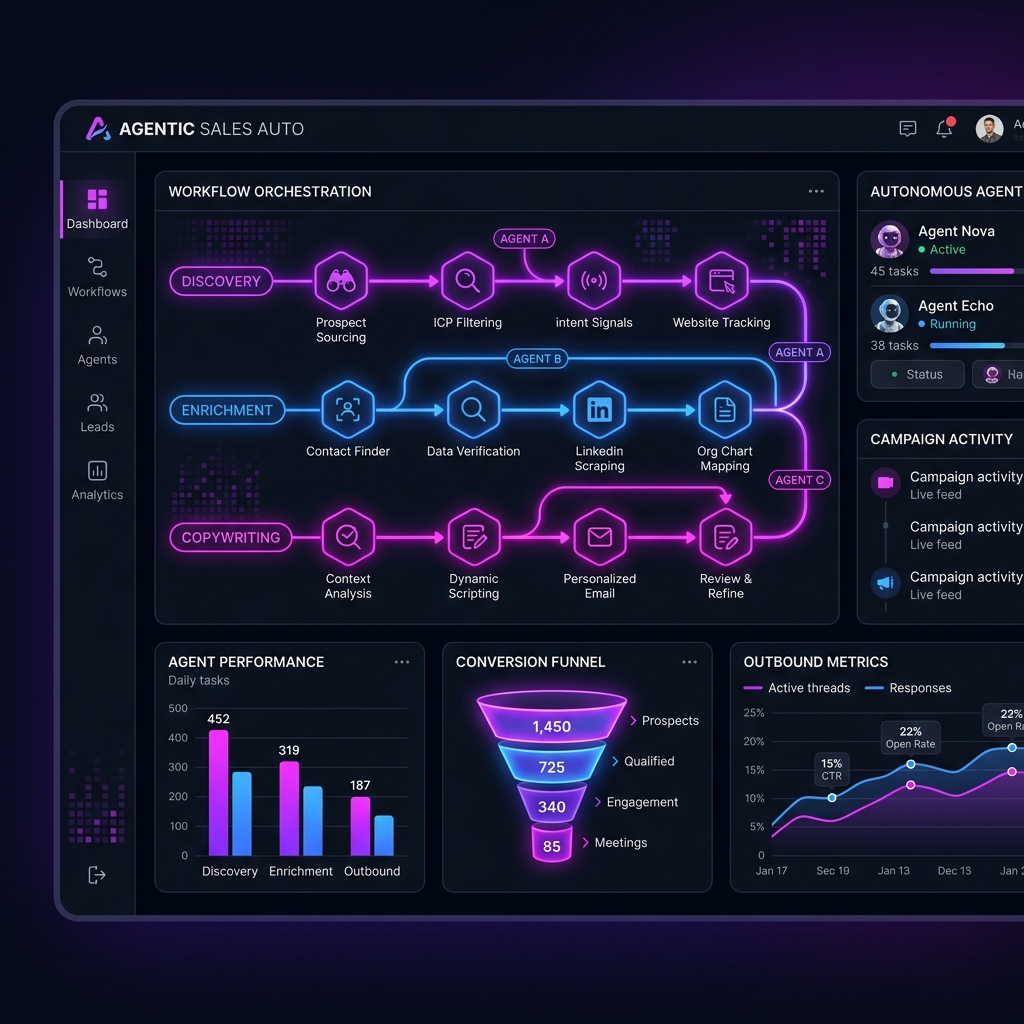
An agentic B2B pipeline operates as a continuous, closed-loop system, executing lead sourcing and outreach automatically.
Here is how the workflow is structured in the Vect AI platform:
graph TD
    A[Intent Scanners: Detect Buying Signals] --> B[Sourcing Agent: Identifies Target Accounts]
    B --> C[Enriched Prospector: Validates Emails & LinkedIn Activity]
    C --> D[Reasoning Classifier: Qualifies Against ICP Parameters]
    D -->|Fails Fit| E[Re-route to Nurture or Discard]
    D -->|Passes Fit| F[Copywriter Agent: Crafts Hyper-Personalized Outreach]
    F --> G[Resonance Assessor: Runs Sentiment Checks]
    G --> H[Outbox: Dispatches Custom Campaign]
1. Intent Detection
The loop begins when the scanner identifies a relevant buying signal, such as new funding, hire openings, competitor migrations, or trending topics in your sector.
2. Sourcing and Enrichment
The sourcing agent matches target profiles, and the enrichment engine verifies the contact details. It checks the email address to prevent bounces and reviews social profiles.
3. ICP Qualification
Using advanced reasoning, the agent evaluates the company's core offering and challenges to determine if they match your Ideal Customer Profile.
4. Copywriting and Quality Review
The copywriting agent writes a targeted outreach message. Before dispatching, the resonance engine runs a sentiment test to ensure the copy aligns with the buyer persona.
3 Playbooks for Deploying Autonomous SDRs
Maximize your pipeline conversion by deploying these automated workflows.
1. The Competitor Displacement Campaign
Turn competitor instability into pipeline opportunities.
- The Playbook: Connect your scanners to monitor competitor product outages, price increases, or negative social comments. Once identified, the agent finds relevant decision-makers at the affected firms and pitches your solution. Learn more in our Competitor Strategy Spy guide.
2. Multi-Channel Signal Syncing
Avoid isolated email campaigns; coordinate your touchpoints.
- The Playbook: Build a multi-channel sequence in the Campaign Builder. Trigger automated emails and coordinate them with LinkedIn touches to increase engagement rates.
3. Simulated Resonance Auditing
Protect your domain sender reputation by testing your copy before sending.
- The Playbook: Run your messaging templates through the Resonance Engine. This tool assesses how different buyer personas will react to the copy, allowing you to optimize engagement.
Launch Checklist for Autonomous Outbound
Use this checklist to configure and launch your first autonomous outreach workflow:
[ ]Load ICP Parameters: Define target industries, employee counts, and job titles in the system settings.[ ]Configure Outreach Domains: Set up dedicated email addresses with active SPF, DKIM, and DMARC settings.[ ]Establish Signal Triggers: Specify target keywords, competitors, and job boards for the agent to monitor.[ ]Provide Case Studies: Upload case studies and value propositions to train the writing model.[ ]Determine Review Workflows: Choose between manual draft review or automated sending settings.
Conclusion
Integrating Autonomous Sales Agents into your Go-To-Market stack is the most efficient way to scale B2B pipeline growth in 2026. By automating the data discovery and outreach phases, your sales team can focus entirely on closing deals.
Ready to deploy your first autonomous sales agent?
For more data on B2B conversion benchmarks, refer to the annual HubSpot Sales Report.
Access your Vect AI account, configure the AI SDR tool, and launch your agentic campaign today.
Stop Reading. Start Scaling.
You have the blueprint. Now you need the engine. Access the full Vect AI Platform and get results in minutes.
Access Dashboard