
Apple Intelligence has turned every iPhone, iPad, and Mac into a local retrieval engine. If your site isn't indexed by Applebot, you are invisible to over a billion active devices.
In 2026, Apple Intelligence represents one of the largest shifts in consumer search behavior. Siri is no longer just a voice assistant; it is a fully integrated agent capable of scraping, summarizing, and recommending web content in real-time. Whether a user asks Siri for the "best marketing automation OS" or searches via Safari Spotlight, the answers are synthesized using on-device models and secure cloud computing.
Winning in this ecosystem requires a dedicated Apple Intelligence SEO strategy. This means understanding how Apple's proprietary crawlers ingest information and formatting your pages to match the constraints of device-level retrieval windows.
In this guide, we break down Apple's crawling architecture and show you how to optimize your brand for Apple Intelligence using Vect AI.
Google AI Overviews vs. Apple Intelligence Siri Answers
Optimizing for Apple's ecosystem requires understanding how it differs from traditional search engines and web-based AI generators.
| Dimension | Google AI Overviews | Apple Intelligence Siri & Spotlight |
|---|---|---|
| Primary Crawler | Googlebot | Applebot / Applebot-Extended |
| Computing Model | Centralized web servers (Gemini) | Hybrid (Local On-Device Models & Private Cloud Compute) |
| User Interface | Web browser SERP | System-wide overlays (Siri, Spotlight, Safari Summaries) |
| Retrieval Focus | Web content consensus | On-device personal context + real-time web retrieval |
| Citations | Multiple inline link tags & side cards | Direct single-source answers with deep-link Safari referrals |
The Apple Intelligence Context Ingestion Lifecycle
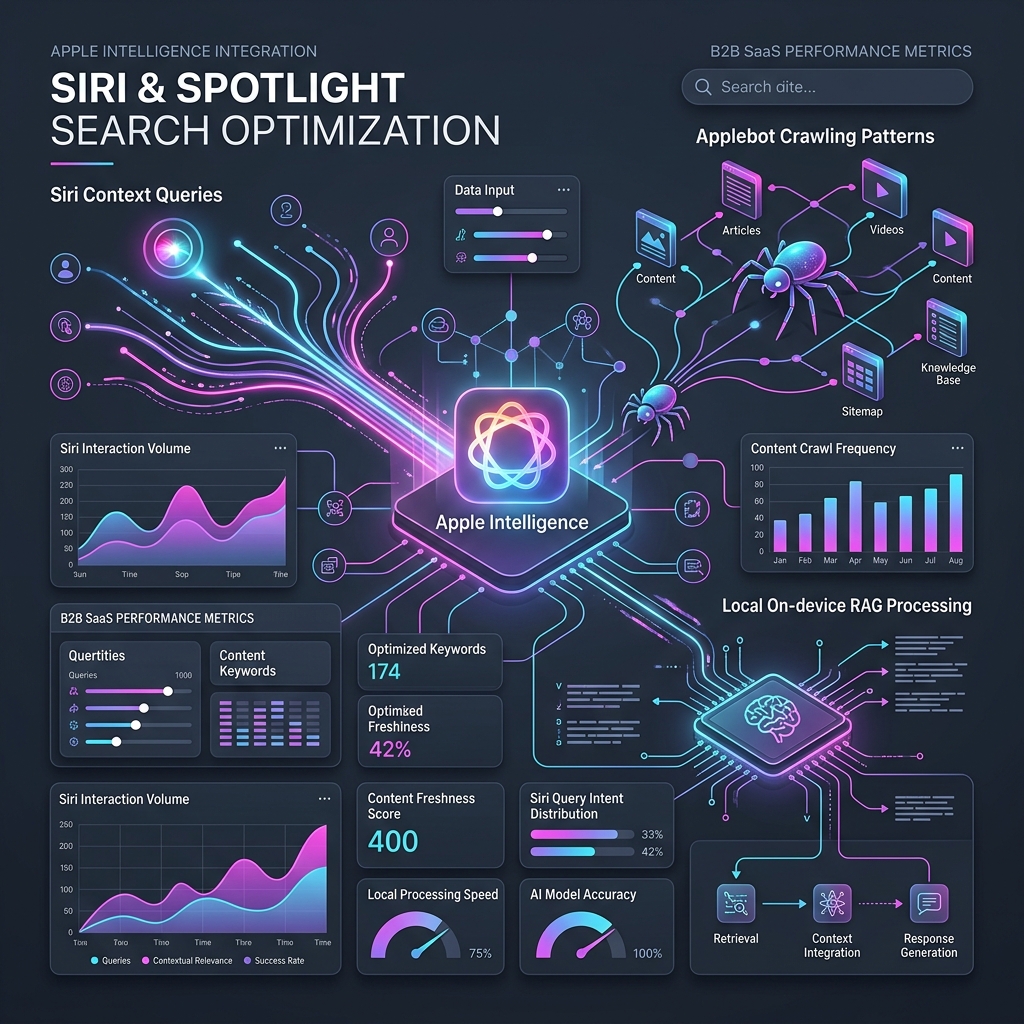
To deliver answers to users, Apple Intelligence processes web content through a secure, structured retrieval sequence.
graph TD
    A[Siri / Spotlight receives user query] --> B[Applebot queries web index for real-time sources]
    B --> C[Private Cloud Compute PCC filters out non-secure pages]
    C --> D[Model processes semantic entities & schema structures]
    D --> E[On-device model synthesizes response in Siri UI]
    E --> F[Attribution link provided to Safari or Spotlight cards]
1. Applebot Web Retrieval
When a user asks Siri a question that requires external knowledge, Applebot fetches matching pages from its web index. If your site blocks Applebot, Siri cannot retrieve your content to answer the user.
2. Private Cloud Compute Routing
To protect user privacy, complex processing is routed to Apple's Private Cloud Compute (PCC). PCC enforces strict security requirements on websites, prioritizing sites with clean HTTPS certificates and fast, lightweight page sizes.
3. Entity-Driven Synthesis
Apple's semantic engine evaluates the retrieved documents. Unlike standard crawlers, Apple's algorithms place heavy emphasis on Schema.org markups to map entity relationships, ensuring that brand details are associated with the correct products and features.
The Apple Intelligence SEO Optimization Strategy
Implement these structural guidelines to optimize your website for Apple Intelligence integration.
1. Fine-Tune Your robots.txt for Applebot-Extended
Apple allows publishers to opt-out of model training while remaining eligible for search citations.
- The Tactic: Do not block
Applebot. Instead, if you want to protect your IP from training future Apple models but still want Siri to cite you, restrictApplebot-Extendedin yourrobots.txtwhile keeping the main user-agent open. - robots.txt Directive:
User-agent: Applebot-Extended
Disallow: /
2. Implement Hyper-Granular Schema Markup
Apple Intelligence relies on structured data to build its knowledge graph of local and global entities.
- The Tactic: Ensure every page has complete, valid JSON-LD schemas. For B2B products, prioritize
ProductandOfferschemas. For blogs, useBlogPostingandFAQPageschemas. This allows Apple to associate your brand name directly with target keywords.
3. Use the BLUF (Bottom Line Up Front) Structure
On-device models operate with constrained memory resources. They prioritize short, highly dense content segments that directly answer user queries.
- The Tactic: Structure your articles with direct H2 questions and immediately follow them with a 1-sentence, factual answer. Use Vect AI's SEO Content Strategist to scan your text and automatically format it for high-density, agent-ready ingestion.
4. Optimize Page Loading for Mobile Ingestors
Since Siri retrieves pages in real-time, any delay in page loading results in the agent skipping your domain for a faster alternative.
- The Tactic: Compress all images, eliminate render-blocking Javascript, and maintain a fast Time to First Byte (TTFB).
Apple Intelligence SEO Checklist
Ensure your website is optimized for iOS and macOS systems:
[ ]Ensure Applebot Crawl Permissions: Confirm that the standardApplebotuser-agent is not blocked in yourrobots.txt.[ ]Apply Valid JSON-LD Schema: Verify your Organization, Article, and Product schemas using search validation tools.- Write Concise Definition Snippets: Place a 45-60 word direct answer immediately below your headers.
[ ]Enable Mobile Optimization: Ensure your website loads in under 1.5 seconds.[ ]Ensure Security Compliance: Maintain valid HTTPS and clean SSL certificates for Private Cloud Compute verification.
Conclusion
Apple Intelligence is transforming the device in your pocket into an active gatekeeper of web traffic. By aligning your website with Applebot’s indexing requirements, implementing semantic schema, and designing content for immediate extraction, you ensure your business remains at the center of Siri and Spotlight search recommendations.
Ready to scale your organic presence across Apple's AI ecosystem?
Log into Vect AI, open the SEO Content Strategist, and build your automated entity-driven optimization engine today.
Stop Reading. Start Scaling.
You have the blueprint. Now you need the engine. Launch the AI agent for "SEO Content Strategist" and get results in minutes.
Launch SEO Content Strategist