
Search is no longer about occupying a position on a list. It is about occupying space in the LLM's mind share.
In 2026, the rise of Answer Engine Optimization (AEO) and Generative Engine Optimization (GEO) has turned traditional search engine optimization on its head. When prospective buyers search for software recommendations or strategy playbooks, they aren't clicking through ten blue links. They are reading synthesized answers generated in real-time by systems like Perplexity, Gemini, and OpenAI's search models.
If your brand isn't appearing as a trusted citation in these answers, you don't exist to these high-intent buyers.
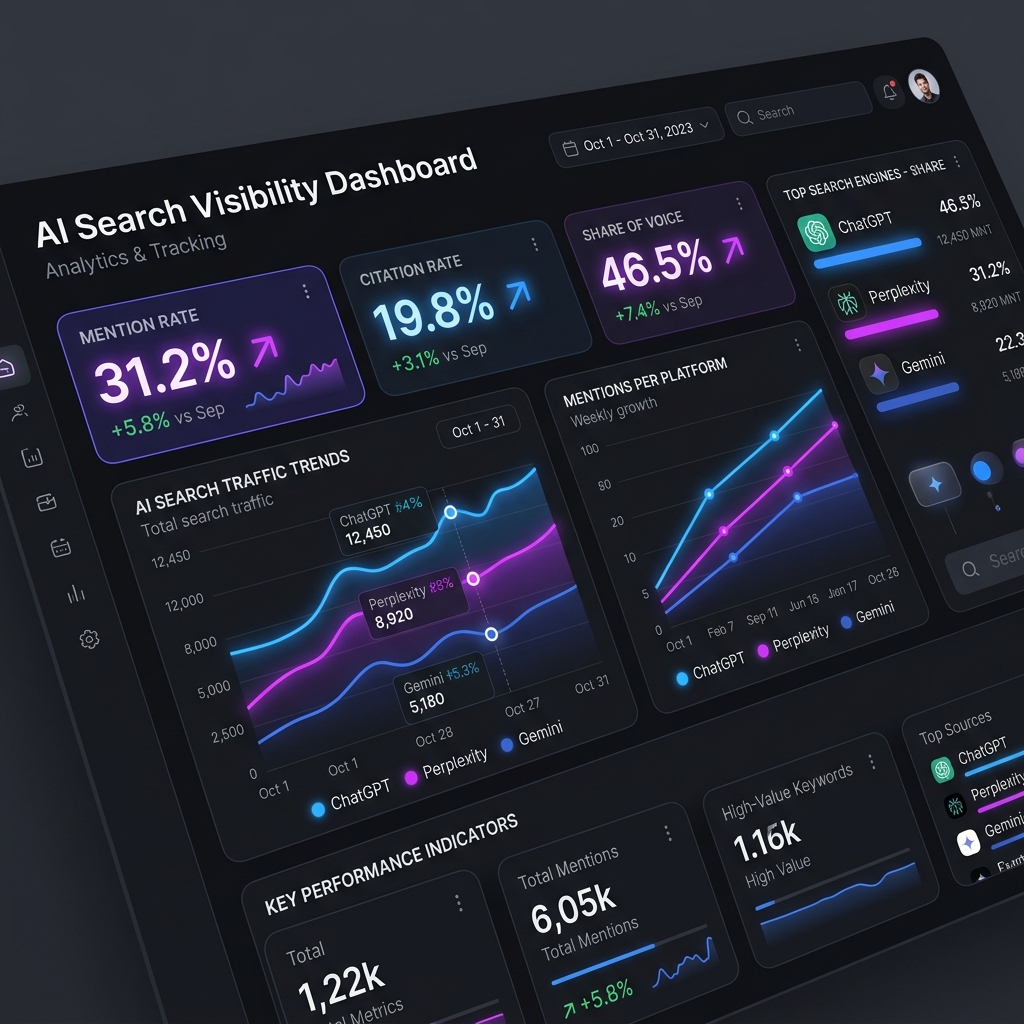
To bridge this gap, modern marketing teams are moving away from traditional keyword tracking and adopting AI Search Visibility tracking. Here is your complete playbook to tracking, measuring, and optimizing your brand's presence in the AI search ecosystem using Vect AI.
Traditional Rank Tracking vs. AI Search Visibility
Optimizing for generative search engines requires a fundamental shift in how we define and measure success.
| Optimization Metric | Traditional Rank Tracking | AI Search Visibility (GEO) |
|---|---|---|
| Primary Target | Specific keyword positions (e.g., Rank #1) | Mention rate and citation frequency |
| Data Nature | Deterministic (same results for most users) | Probabilistic & highly personalized |
| Output Type | Direct click-through to site | Conversational synthesis with inline citations |
| Measurement Focus | Search volume & keyword difficulty | Brand-to-intent entity association |
| Primary Vector | Technical tags and PageRank | Factual consensus and structural clarity |
How AI Search Visibility Tracking Works
Measuring visibility within AI search engines requires simulating real-world buyer prompts, extracting responses, and evaluating attribution. Here is the operational workflow for tracking your brand's footprint:
graph TD
    A[Define High-Intent B2B Prompt Sets] --> B[Execute Automated API Queries across LLMs]
    B --> C[Parse Conversational Responses & Text Content]
    C --> D[Identify Brand Mentions & Core Competitors]
    D --> E[Extract Inline Citation Links & Attributions]
    E --> F[Calculate Share of Voice & Mention Rate]
    F --> G[Optimize Content via Vect AI Content Loop]
    G --> A
1. Defining Prompt Sets
Unlike traditional keywords, AI prompts are conversational and intent-driven. You must build a set of queries representing:
- Direct Brand Queries: "What does Vect AI do?"
- Category Comparisons: "Compare Vect AI vs. Jasper and Copy.ai for B2B copywriting."
- Problem-Solving Intent: "How do I scale programmatic SEO campaigns dynamically?"
2. Automated Parsing & Extraction
Because AI search is probabilistic, you must query the engine multiple times to build a statistically valid sample. Advanced scrapers and API partners extract the generated text and analyze the sources that were crawled to build the answer.
3. Share of Voice (SOV) Calculations
By comparing how often your brand is recommended versus your core competitors for a specific category prompt, you calculate your AI Share of Voice. This is the new benchmark for search engine authority in 2026.
Step-by-Step Strategy to Maximize AI Visibility
Once you've established your visibility baseline, implement these optimization plays to secure more citations:
1. Build the "Factual Consensus Engine"
AI models retrieve information from multiple sources and cross-reference details to establish consensus. If your product specs on your website conflict with details in your documentation or G2 profile, the AI will default to the most frequent consensus.
- The Tactic: Use Vect AI's Competitor Strategy Spy to align your brand details, pricing models, and feature highlights across all digital channels, ensuring a unified footprint that AI models can verify instantly.
2. Optimize for Retrieval-Augmented Generation (RAG)
To make your content easily discoverable by search bots, you must structure pages with clear semantic markdown hierarchies. Avoid embedding critical data in un-crawlable formats.
- The Tactic: Structure your articles with clear
h2andh3tags, use bulleted lists for steps, and build markdown tables for product comparison tables. This enables the LLM parsing engines to quickly clip your data and cite it as a source.
3. Deploy "LLM-Optimized" Meta Schemas
Ensure that crawler-specific files are fully configured. Generating and maintaining an up-to-date llms.txt and rich structured JSON-LD schemas is mandatory.
- The Tactic: Use Vect AI's SEO Content Strategist to continuously monitor and inject
BlogPosting,FAQPage, andProductschema markups into your pages, validating them for AI search ingestion.
AI Search Visibility Checklist
Ensure your digital assets are fully optimized to rank in generative search:
[ ]Verify Crawler Permissions: Ensurerobots.txtdoes not blockGPTBot,PerplexityBot,ClaudeBot, orGoogle-Extended.[ ]Establish Direct Answer Hooks: Place a 2-sentence direct answer immediately under your main article headings.[ ]Implement Rich Schema Markup: Populate schema data specifying brand entity details, founders, and core software tools.[ ]Verify Off-Site Consensus: Match competitor mentions in high-authority directory sites and forums.[ ]Monitor Mention and Citation Rates: Perform weekly checks to track brand presence in response sets.
Conclusion
Winning in 2026 is no longer about tricks to manipulate traditional search engine algorithms. It is about delivering clear, factual, and deeply structured content that AI models trust. By measuring your brand's AI Search Visibility, you gain the precise insights needed to adjust your positioning and dominate the generative web.
Ready to automate your AI search tracking and scale citations?
Log into Vect AI, open the SEO Content Strategist, and deploy your AI-optimized visibility workflow today.
Stop Reading. Start Scaling.
You have the blueprint. Now you need the engine. Launch the AI agent for "SEO Content Strategist" and get results in minutes.
Launch SEO Content Strategist